
Why Jira Governance Fails Long Before Anyone Notices
 Maria Reisinger·2026-08-03·7 min read
Why enterprise Jira teams eventually stop struggling with configuration and start struggling with understanding
Last week, I had the pleasure of speaking with Matthew Sinclair as part of my interview series, 5 Questions in the Atlassian Universe. Matthew manages Atlassian products in a large enterprise environment, where his work focuses on governance, Jira administration, Jira Service Management, automation, and change management. We talked about the realities of enterprise governance, the challenges of managing Jira at scale, and the importance of maintaining consistency as organizations evolve. Among the many valuable insights he shared, one observation stayed with me long after our conversation had ended:
“Governance is more than safety. It’s bringing order out of chaos.”
At first glance the statement seems simple. The longer I sat with it, the more it captured one of the most fundamental challenges facing enterprise Jira environments today. Many organizations believe governance begins with policies, naming conventions and approval processes. Those things matter, but they are only part of the picture. Governance becomes difficult long before anyone notices that standards are no longer being followed. The real challenge begins when an organization gradually loses visibility into how its Jira environment is evolving over months and years.
How Complexity Accumulates Quietly
Every enterprise Jira environment starts the same way. One team creates a custom field because it needs to capture additional information. Another introduces a workflow status that better reflects its delivery process. A department adds an automation rule that solves a local problem. Every decision is reasonable, every configuration solves a genuine need, and nobody believes they are creating future complexity.
And they aren’t not individually. Complexity almost never appears overnight. It accumulates through hundreds of well-intentioned decisions made independently by different teams. Each makes perfect sense in isolation, yet the combined effect slowly reshapes the entire landscape.
Consider one ordinary example. One team marks finished work as “Done.” Another calls the same state “Closed.” A third introduces “Resolved” because it fits their process better. Each choice is perfectly reasonable inside its own project. But when leadership asks a simple question across two hundred projects “how much work is actually complete?”, there is no longer a reliable answer. The information exists; it has simply drifted apart into statuses that no single view reconciles. This is configuration drift, and it rarely begins as a major problem. It starts with small inconsistencies that quietly add up.
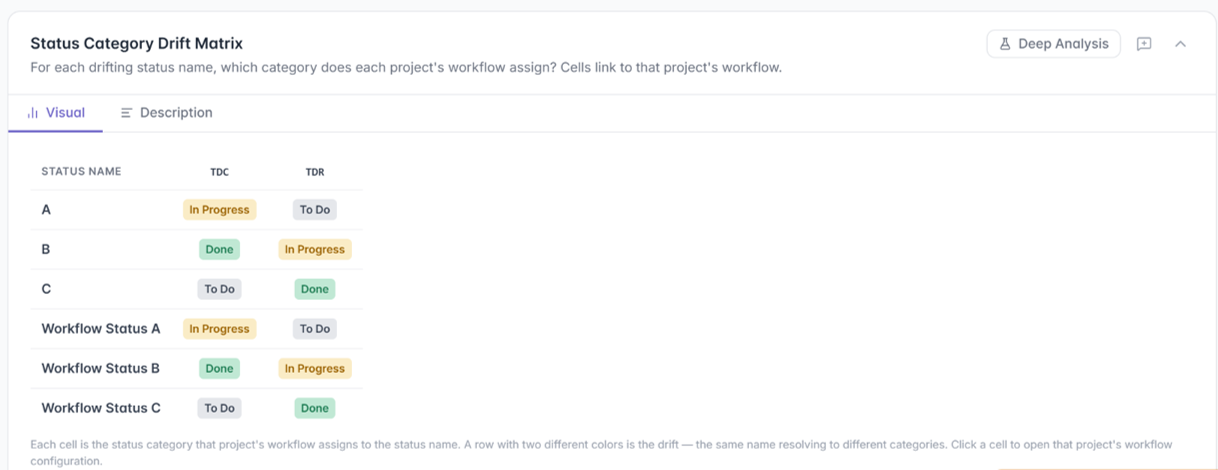
While individual projects may appear perfectly healthy, enterprise-wide visibility often reveals that identical workflow statuses are being interpreted differently across teams.
Several years later, organizations discover they are no longer asking operational questions but governance ones. Why do different projects use different statuses to describe the same business state? Why do multiple custom fields collect nearly identical information under different names? Which workflows still represent the standard, and which have become local exceptions, and when did that happen? None of these questions can be answered by looking at a single project. They only become visible when someone looks across the entire environment.
From Reactive to Proactive: Three Stages of Visibility
It helps to think of governance visibility as a progression through three stages. Most organizations can locate themselves on this map surprisingly quickly.
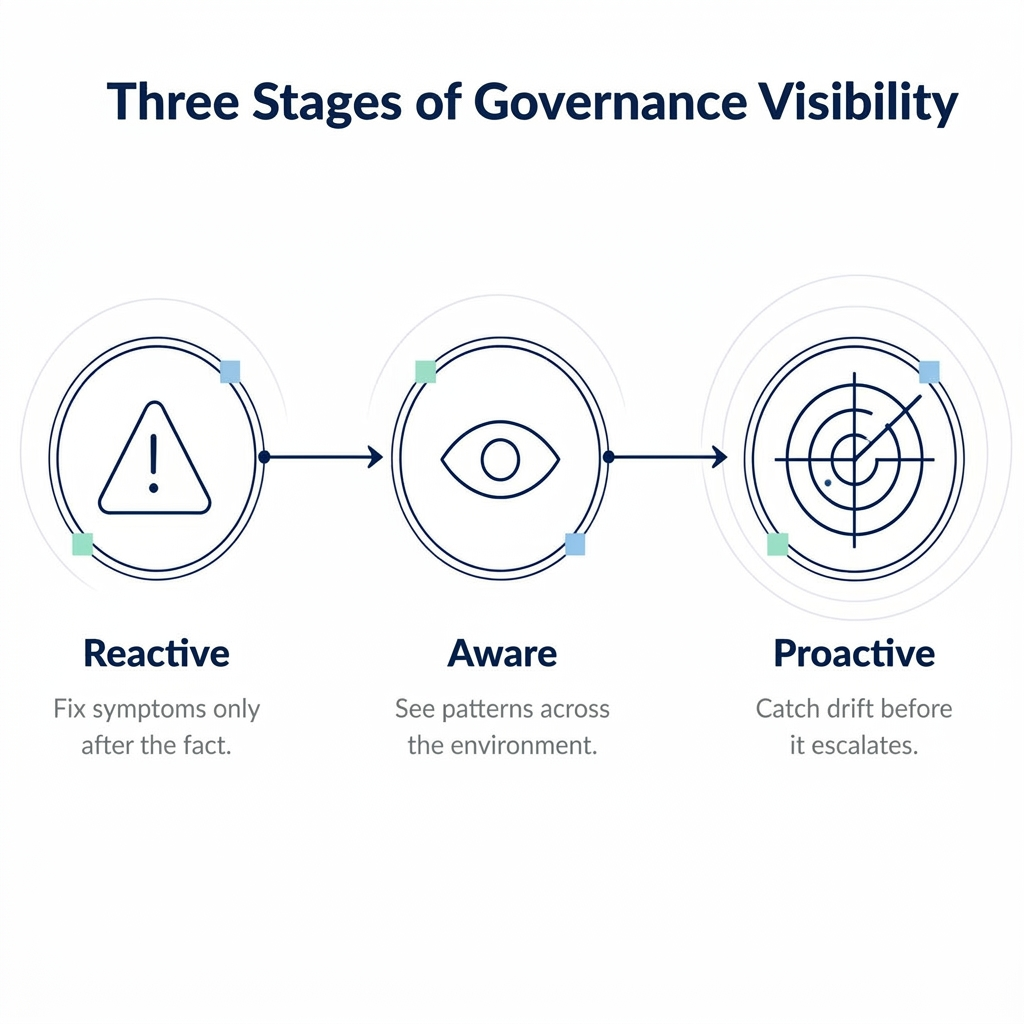
Reactive. Administrators respond to symptoms. A report looks wrong, an audit raises a flag, a team complains, and only then does anyone investigate. Governance becomes a series of corrections after the fact.
Aware. Administrators can finally see across the environment. Patterns become visible: the duplicate fields, the divergent statuses, the workflows that quietly became local exceptions. The problems are understood, even if they are not yet prevented.
Proactive. Administrators recognize drift as it emerges, before it reaches reporting, compliance or day-to-day operations. The question is no longer “What changed today?” but “What has been changing over the past six months?”, and that question finally has an answer.
Most enterprise Jira environments live in the reactive stage without realizing it. The move toward proactive governance is less about stricter rules and more about earlier sight.
A quick way to locate your own environment on this map is to ask a few honest questions. Without opening projects one by one, can you say how many different statuses in your instance actually mean “done”? Do you know which custom field was created most recently, and why? Can you name what has structurally changed in your configuration over the past six months? If these questions are hard to answer, the issue is rarely discipline. It is visibility.
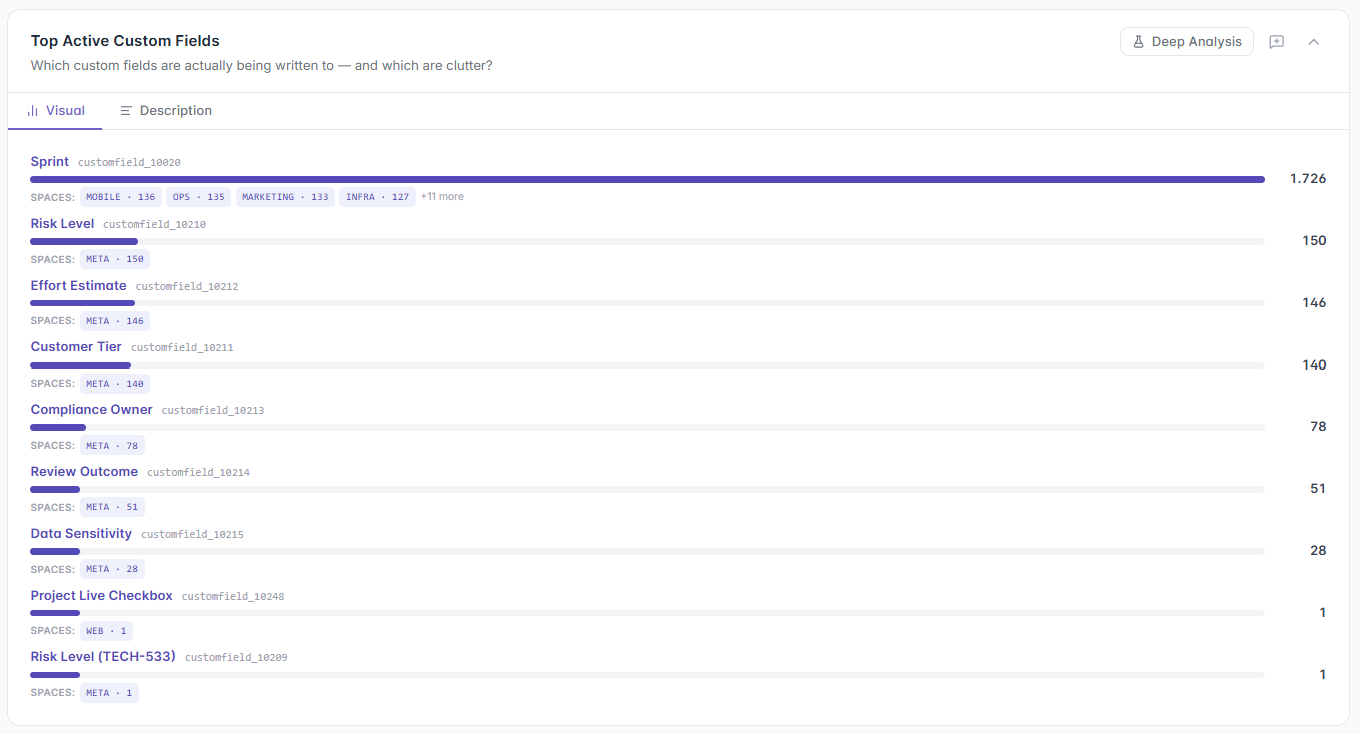
Looking at individual custom fields rarely tells the whole story. Understanding usage patterns across projects reveals where standardisation exists, where duplication is emerging and where complexity is beginning to grow.
Operational Intelligence Changes the Conversation
When organizations reach this stage, traditional reporting is no longer enough. Dashboards still provide useful metrics, audit logs still record activity, reports still summarize completed work. None of that is wrong. It simply answers a different question.
Operational reporting tells us what happened: how many issues closed, how many projects exist. Operational intelligence is different. It looks at how those facts relate to one another over time, whether configuration is converging on shared standards or drifting apart, whether growing complexity reflects genuine business growth or quiet erosion. Reporting describes the environment. Intelligence explains where it is heading.
That distinction changes how enterprise Jira is managed. Instead of reviewing hundreds of individual changes, administrators look for patterns. Instead of investigating isolated incidents, they identify trends before those trends become problems. Visibility stops being a reactive exercise and becomes a continuous capability.
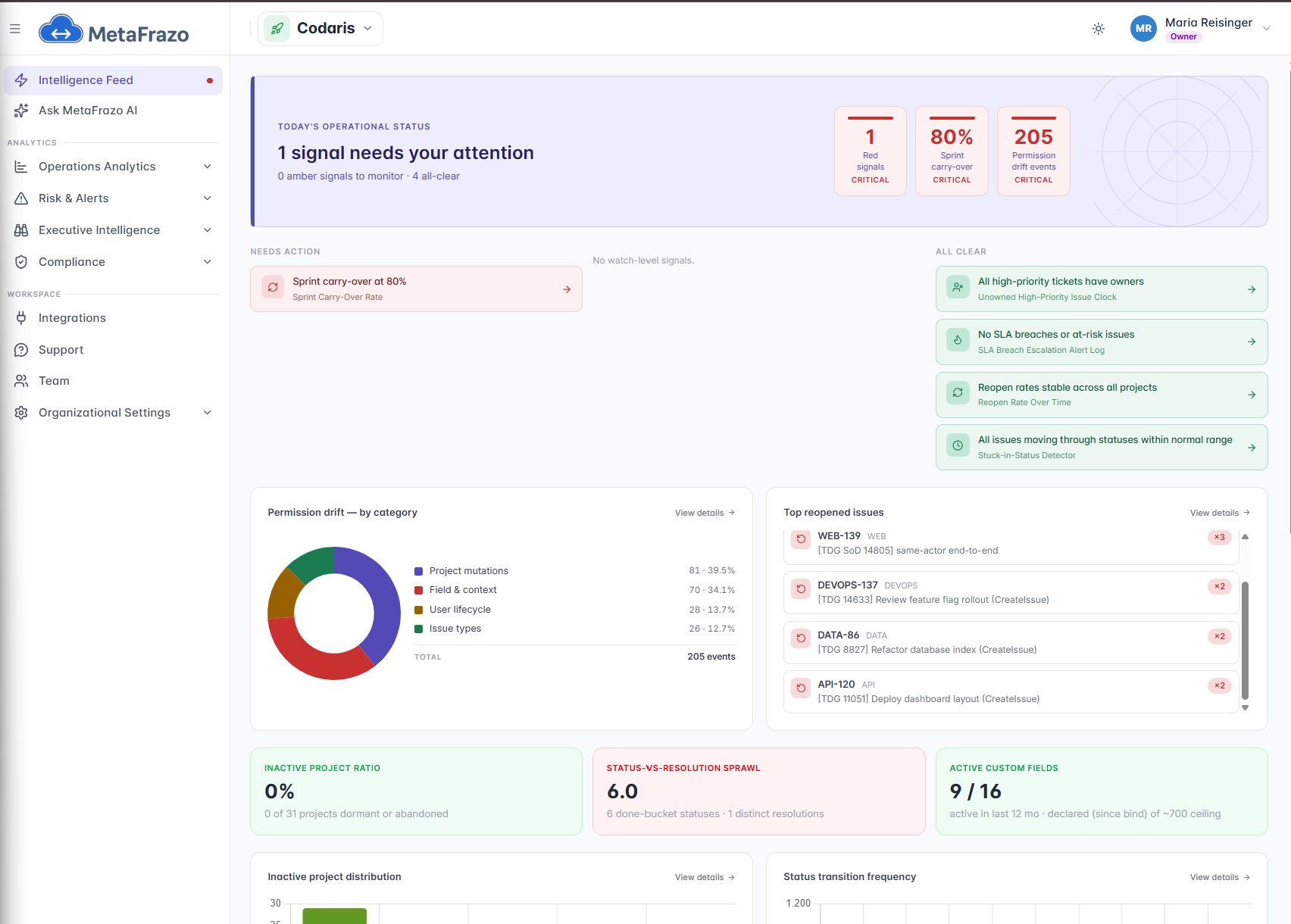
Operational intelligence shifts the focus from isolated events to enterprise-wide patterns, allowing administrators to detect governance risks before they become operational issues.
Making the Invisible Measurable
Healthy governance is not defined by how many projects, issues, or workflows an organization manages. It is defined by the consistency with which those assets are designed, maintained, and used over time. That consistency becomes visible when standards remain stable across projects, unnecessary complexity is reduced instead of accumulated, and administrative decisions become easier because teams understand how their Jira environment is evolving.
This perspective is the foundation of MetaFrazo. It was never designed to be just another reporting app. Rather than simply counting issues or workflows, it analyzes the relationships within your Jira metadata and reveals insights that typically remain hidden. It identifies custom fields that collect nearly identical information under different names, highlights workflows that have gradually drifted away from organizational standards together with when that drift began, and uncovers archived projects that continue to consume valuable configuration resources. Ultimately, it transforms the questions raised throughout this article into clear, actionable answers, all without exporting sensitive business data.
The result is not simply more information. It is better decisions.
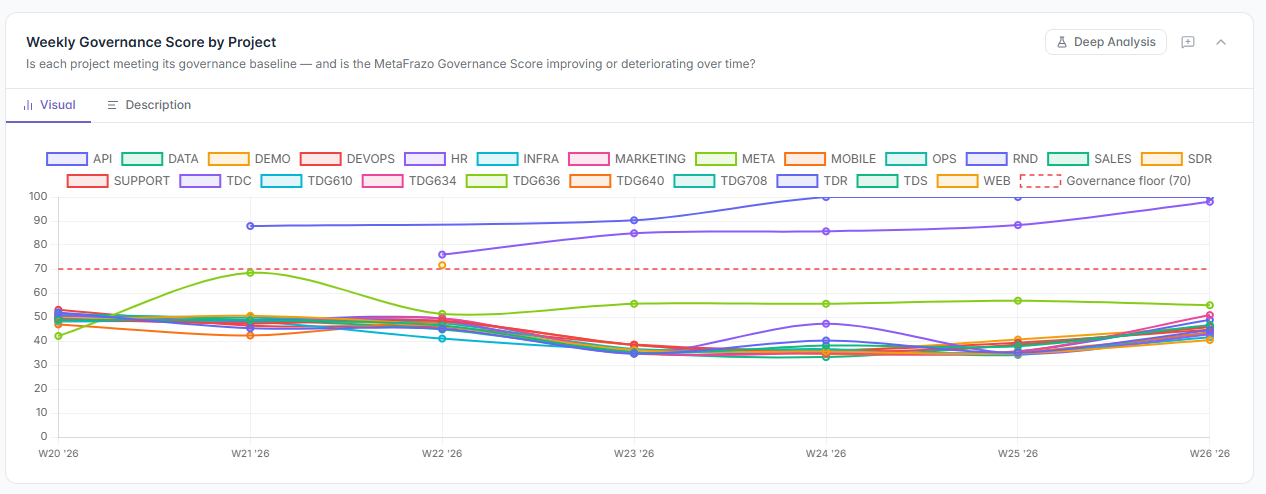
Governance becomes measurable when configuration consistency, workflow stability and operational maturity can be monitored continuously instead of being reviewed only during audits or large transformation projects.
Governance Is Never Finished
Perhaps the most important lesson from that conversation is that governance should never be viewed as a project with a clear beginning and a definitive end. Enterprise Jira environments evolve every day because the organizations using them never stand still. New teams join, processes mature, regulations shift, products expand. Effective governance is not about limiting change but about keeping it transparent, understandable and aligned with organizational standards. Visibility provides the foundation, governance sets the direction, and operational intelligence supplies the continuous awareness that keeps both moving together.
That is what keeps the "Done, Closed, Resolved" issue, along with the countless quieter inconsistencies that exist across every enterprise Jira environment, visible instead of allowing them to accumulate unnoticed. As Matthew put it during our conversation:
“Governance is more than safety. It’s bringing order out of chaos.”
Bringing order out of chaos begins with making the invisible visible.
About MetaFrazo
MetaFrazo provides Operational & Compliance Analytics for Jira, helping enterprise organizations transform everyday Jira activity into operational intelligence. By continuously analysing configuration patterns, governance indicators and operational signals, MetaFrazo enables teams to strengthen governance, identify configuration drift and make better informed decisions — without exporting sensitive business data.
Rate this post
Related articles
5 Questions in the Atlassian Universe with Kevin Behrens
Kevin Behrens, Lead Architect for Enterprise Strategy & Planning at catworkx, on the question that really matters after every cloud migration: what happens once you're live? Five questions on platform sprawl, governance as an architectural principle, and the future of AI-driven workflows in the Atlassian ecosystem.
2026-08-13
Traceability is not a Jira problem
Four security dimensions in Spain's ENS can be bought and configured. Traceability cannot. Why audit evidence has to be created while the work happens, and what that means for Jira.
2026-09-29
Atlassian Analytics and Jira Governance: Who Owns the Query?
Every audit asks the same Jira questions, and nobody owns the query. What Atlassian Analytics offers, who it is built for, and where MetaFrazo adds to it.
2026-09-28