

5 Questions with Rolf Eriksen: Jira App Security
 Maria Reisinger·2026-10-28·9 min read
About Rolf
Rolf Eriksen · Founder, Eriksen Labs · Drammen, Norway
"A promise not to misuse your data is worth less than not being able to reach it."
Rolf Eriksen runs Eriksen Labs, a one-person studio in Norway that builds small Atlassian Forge apps: Mermaid Diagrams & Gantt for Confluence, Recurring Requests & Templates for Jira Service Management, and Issue Templates & Create Defaults for Jira. He also makes the open-source tool what-it-does, and he tests how Forge behaves using isolated test apps. Before building software, he ran shifts in busy restaurants.
Areas of expertise: Atlassian Forge · Jira Service Management · Confluence apps · app permissions and data handling · platform testing and reproductions · open-source developer tools
1. You moved from leading teams in high-volume operations into building Forge apps and learning security operations. What from those busy shifts do you still use when you build software?
Mostly two things: decide what good looks like before the rush starts, and say plainly what you didn't get to.
In a busy restaurant you can't fix much once the rush has started. So before doors open, you check the line: every station stocked, prep done, fridges at temperature, and the kitchen and the floor agree on what's off the menu tonight. On the nights that check got skipped, you found out at eight o'clock, with every table full, that a station was short and a server had already sold the special.
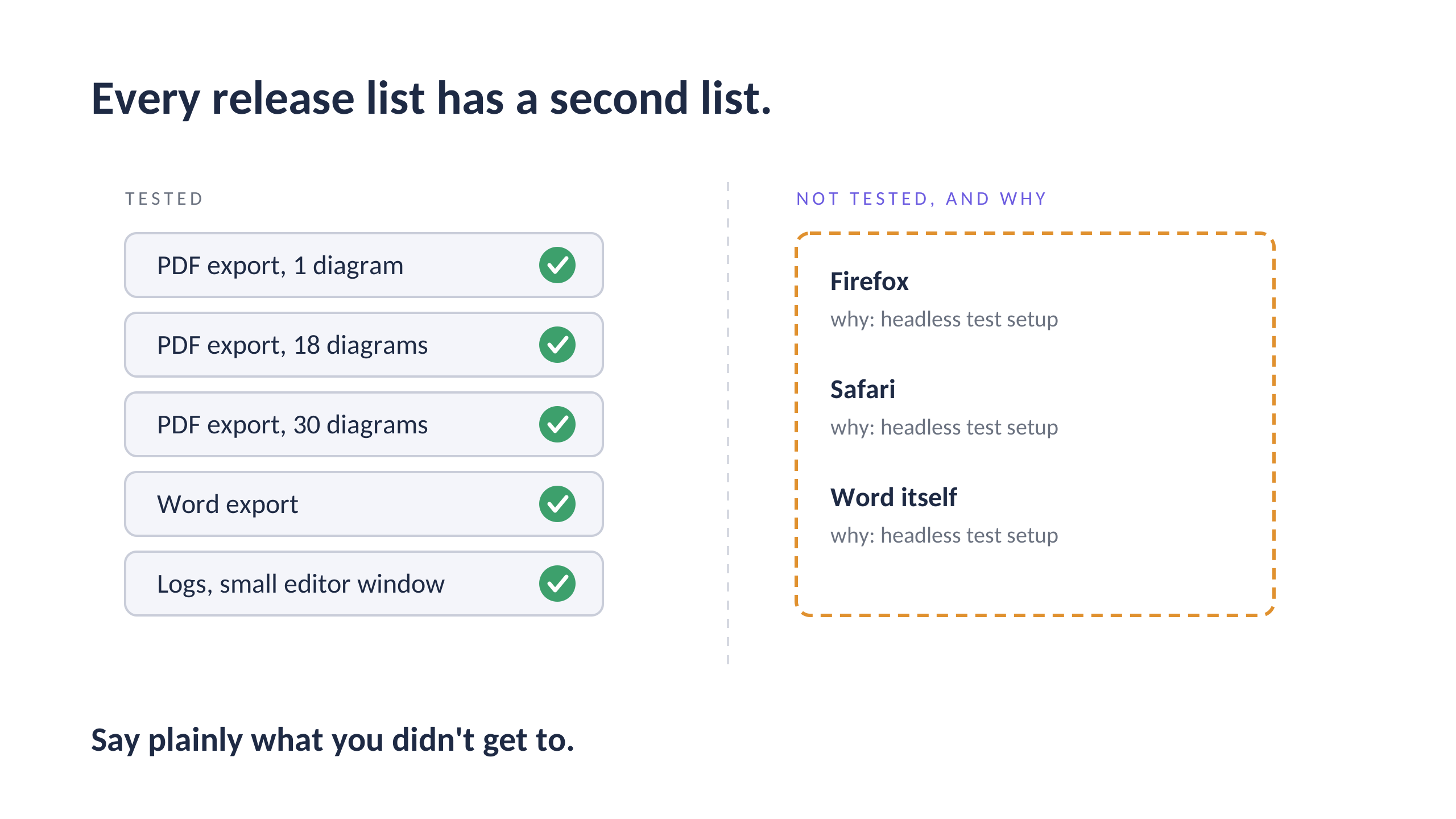
I build software the same way. Before I look at ideas for a new app, I write down what an idea has to pass, and once I've seen the candidates, the bar doesn't move. Before a Mermaid release that touches exports, a written checklist gets run: PDF and Word exports of pages with 1, 18 and 30 diagrams, the logs, and the editor in a small window.
The second habit comes from handover. At close you write notes for whoever opens: what ran out, what broke, what you didn't get to. A note that says "all good" when it isn't costs the next shift its morning. So every release checklist has a second list underneath: what wasn't tested, and why. Last time that included Firefox, Safari and Word itself, because my test setup only runs a headless browser.
And you taste before it goes out. In August, two bugs in my open-source tool got past every automated check. I only found them by clicking through it myself, in the hour before I posted about it.
Illustration, not product data.
2. You deliberately keep your apps small, each one focused on a single workflow problem. Why that choice, and how do you decide which problem is worth an app?
Because the size of an app is the size of what can go wrong with it. Eriksen Labs is one person, and a Norwegian sole proprietorship carries unlimited personal liability. So I set a rule early: my apps add things, and they never edit or delete what a customer already has. Mermaid only draws diagrams. Recurring Requests only adds: new requests, and a short comment on the original if a schedule stops. The worst it can do is an extra ticket somebody cancels.
To choose a problem, I fix the criteria before I look at any ideas. Issue Templates cleared the first set: proven demand, nothing native from Atlassian, buildable by one person in three weeks without data leaving Atlassian, and it only adds. Before building it, I spent a day testing the riskiest part, to see whether it could work at all. Since then the bar is higher: the job has to come back every week or touch compliance or money, and people have to already pay for it. The three searches after Issue Templates found no new app worth building, so I didn't start one; the time went into the apps I already have.
I also ran the numbers on the public Marketplace data. Among smaller vendors, the link between how many apps they have and their installs was about what you get by shuffling apps between vendors at random. More apps means more draws, not better draws.
3. You test how Forge actually behaves with isolated test apps and reproductions. What has surprised you most so far?
How often a rule I was sure of turned out not to be one.
In late September, with the macro's export function handing PDF back to the live view, every export I tried of a page with twelve or more Mermaid diagrams failed, five out of five; without that function, the same kind of page exported fine. Another developer saw the same with his own heavy Mermaid macro. I wrote it down as a twelve-diagram limit. Then on 2 October, pages with 18 and 30 diagrams exported fine, and one of three 12-diagram pages failed. Something may have changed in between, the exporter's own browser version included, but the "limit" didn't hold.
So I built an instrumented copy of the macro. On fresh copies of a 12-diagram page, every diagram had rendered and reported ready within eight seconds of the click, and was on screen well before the export ended, yet three of nine exports still failed at about 240 seconds. That points to something that happens after the app has done its part, though I can't see what.
The second surprise: the exporter takes a picture of whatever the macro is showing at that moment. A test macro that said "ready" while still on its loading screen went into the PDF still loading, seven times out of seven. It also backs a choice I'd already made in September: since version 2.4, Mermaid saves a picture of each diagram when you save it and hands the exporter that picture (older diagrams get it once they're saved again).
The lesson for me is that one site and a handful of runs make a lead, not a rule. I say so when I share results, and none of this has been confirmed by Atlassian.
4. When an auditor asks "who changed this, when, and why" and the change was made by an app or an automation, how well can a typical Jira or Confluence site answer, and where does it fall short?
It can usually answer when, often answer who, and rarely answer why.
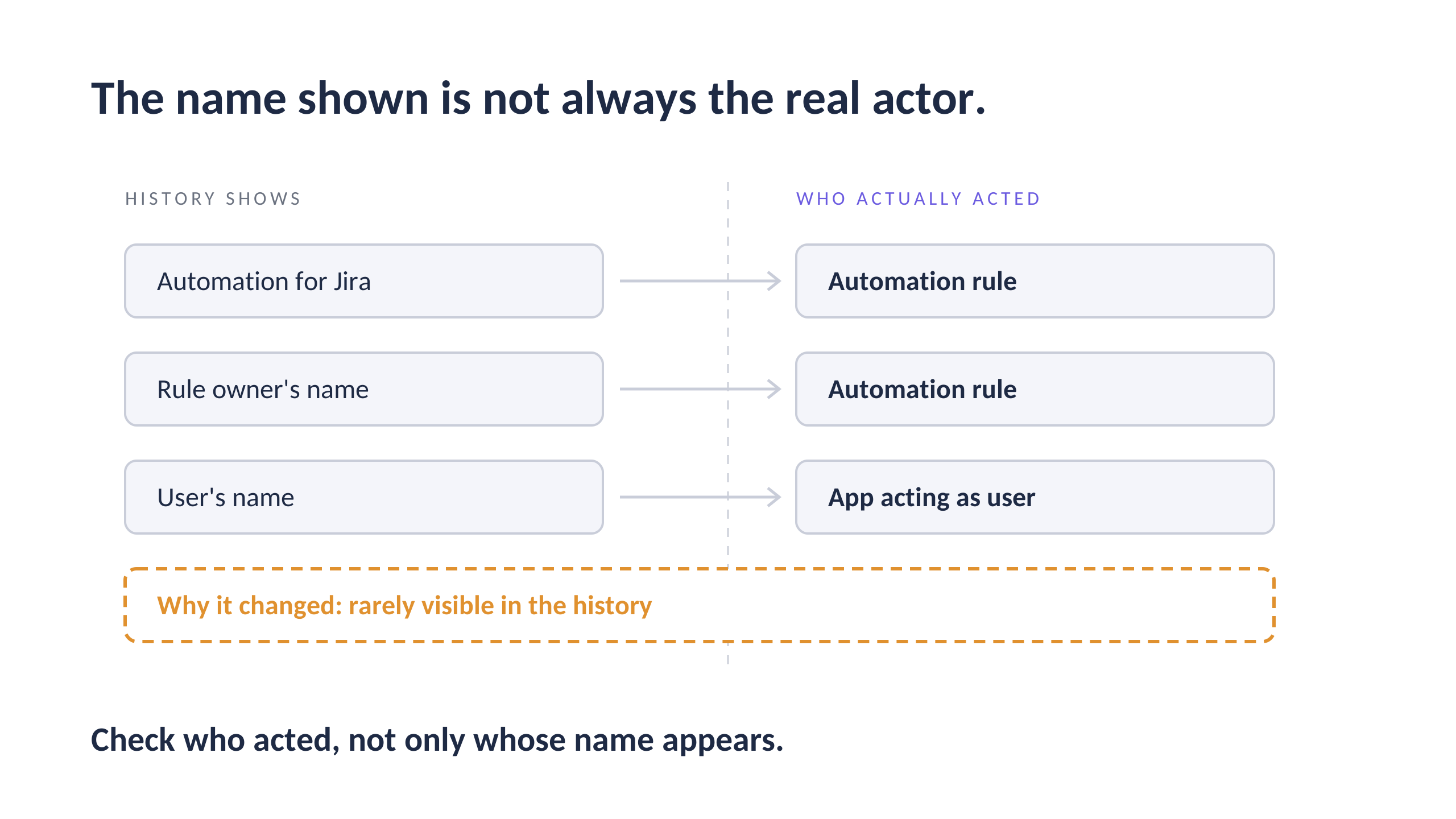
Most changes in Jira and Confluence carry a time and an author, and that part is solid. The catch is that the author isn't always the real actor. A Jira Automation rule shows up as "Automation for Jira", or as whichever person the rule is set to act as. In Confluence, a rule (Atlassian now calls them flows) acts by default as the person who created it. To find which rule did it, you go to the automation audit log, which keeps 90 days. Atlassian has a ticket in progress to add more detail there and in issue history, and to keep it longer.
Apps split in two. An app acting as itself appears under its own name. An app acting as a user appears under that user's name. My own Recurring Requests works that way by design: a scheduled request is raised as the customer who set it up, and in my test the portal showed the request as raised by the schedule's owner. Project admins can see each schedule, whose it is, what it copies and how its last run went. The app adds no marker to the new request itself.
The why is the weakest part everywhere. Jira's API has a field meant for it, historyMetadata, but other developers report that it doesn't show in the issue view, so an auditor reading the history wouldn't see it.
Illustration, not product data.
5. With a security mindset: what should a team ask any Marketplace app before they install it?
The vendor fills in the Privacy & Security tab itself. Atlassian looks at those disclosures as part of its monitoring, but it's clear that judging an app against your own standards is your job. So ask the vendor directly:
Can it act as one of our people when nobody is signed in? If it can, its actions show up under that person's name. Recurring Requests does, by design.
When it acts as itself, what can it reach that our people can't? Calls made as the app don't use the person's own permissions.
What is each scope actually used for? The scope list shows the most an app is allowed to do, not what it does.
Is what we approved still what's running? Minor versions install without asking an admin.
Where can data leave, and can we stop it? Switching off analytics only covers analytics. Any other domains the app declared are a separate list, so read it.
What does the vendor see in its logs? App log sharing switches on at install, and admins can turn it off for each app.
What keeps running, and what stays, after we switch it off or uninstall? Forge's docs say an app's stored data is kept for 28 days after uninstall. Until September, my own security questionnaire said uninstalling removes all of the app's data, because a reinstall came back empty. That empty reinstall proved nothing.
A promise not to misuse your data is worth less than not being able to reach it.
Five lessons from Rolf Eriksen
-
Decide what good looks like before the rush. And write down what was not tested, and why.
-
Limit what can go wrong. The smaller an app or a change, the smaller its worst case. Set the criteria before you look at the options.
-
A handful of runs make a lead, not a rule. Say so when sharing results.
-
Check who really acted. An automation or an app can appear under a person's name, and the why is the weakest part everywhere.
-
Ask what an app can reach, not only what it promises. Actions in a person's name, scopes, logs and data after uninstall all belong on the list.
Thank You
Our sincere thanks to Rolf Eriksen for answers built on his own tests, from the checks before a release to who really acted in Jira and what an app can reach, with every limit stated as clearly as every finding.
We truly appreciate your time and your openness.
About this series
5 Questions in the Atlassian Universe is an interview series by MetaFrazo featuring experienced practitioners from across the Atlassian ecosystem.
Each conversation explores practical lessons and real challenges from people who build, run and grow work in the Atlassian ecosystem.
Because the best ideas don't come from tools alone. They come from the people who use them every day.
About MetaFrazo
MetaFrazo turns the events of your Jira Cloud site into operational, governance and compliance analytics. See what changed. See who changed it. Without building a report.
Events are stored and processed in the EU. MetaFrazo identifies actors by their Atlassian account ID, not by name, and no Jira credentials are ever stored.
www.metafrazo.cloud · Available on the Atlassian Marketplace
See you in the next edition of 5 Questions in the Atlassian Universe.
Interview conducted in writing, October 2026.
Rate this post
Related articles
5 Questions with Akash Singh (Uber)
Akash Singh, Atlassian Solution Architect at Uber, on what Jira admins should record before an incident and what to ask any Marketplace app.
2026-10-15
5-questions-in-the-atlassian-universe-with-rishabh-jhawar
Rishabh Jhawar of Beyond Key on asking why before you build, moving procurement out of Excel and what an audit trail needs to explain later.
2026-11-12
5 Questions with Jacek Wizmur-Szymczak: Jira Integrations
Jacek Wizmur-Szymczak of Getint on connecting Jira with ServiceNow and other tools, why synced data loses its meaning and how to plan traceability.
2026-11-05