

5-questions-in-the-atlassian-universe-with-rishabh-jhawar
 Maria Reisinger·2026-11-12·11 min read
About Rishabh
Rishabh Jhawar · Associate Director, Product, Beyond Key · Indore, India
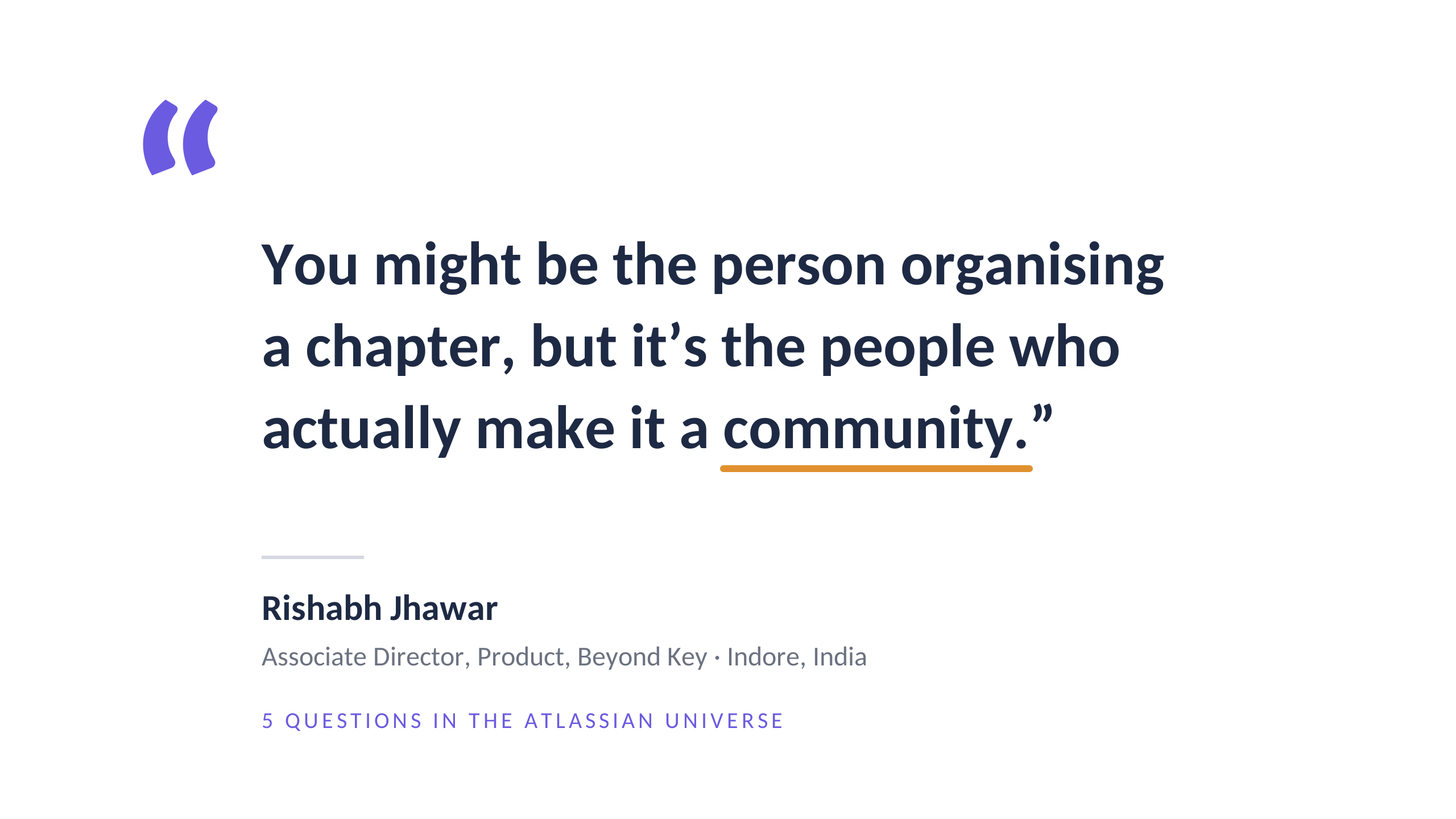
"You might be the person organising a chapter, but it's the people who actually make it a community."
Rishabh started on the code side of products and over the years moved closer to customers, strategy and the decisions behind what actually gets built. As Associate Director, Product at Beyond Key, he works at the intersection of product, procurement and technology. He is an Atlassian Community Champion, helped build the Atlassian Community in Indore and now also leads the chapter in Bhopal. He hosts ProcurePeers, conversations with people working across procurement, product and technology.
Areas of expertise: Product Management & Strategy · B2B SaaS · Procurement Technology · Workflow Automation · Jira & Confluence · Atlassian Community Building
1. You started on the code side and moved closer to customers and strategy over the years. How has that changed the way you decide what actually gets built?
I think starting my career as a developer has played a huge role in making me what I am today.
Back then, I was primarily focused on how to build something. Over the years, as I moved into customer-facing roles, product management, and strategy, my perspective changed quite a bit.
Today, when I'm making product decisions, I'm not just looking at business requirements, customer needs, strategy, or ROI. I also have that technical understanding of how things actually work behind the scenes.
I understand how code works, how systems are architected, and what goes into building a solution. That makes conversations with customers, developers, and other stakeholders much easier.
But one thing that has changed significantly is how I approach requirements.
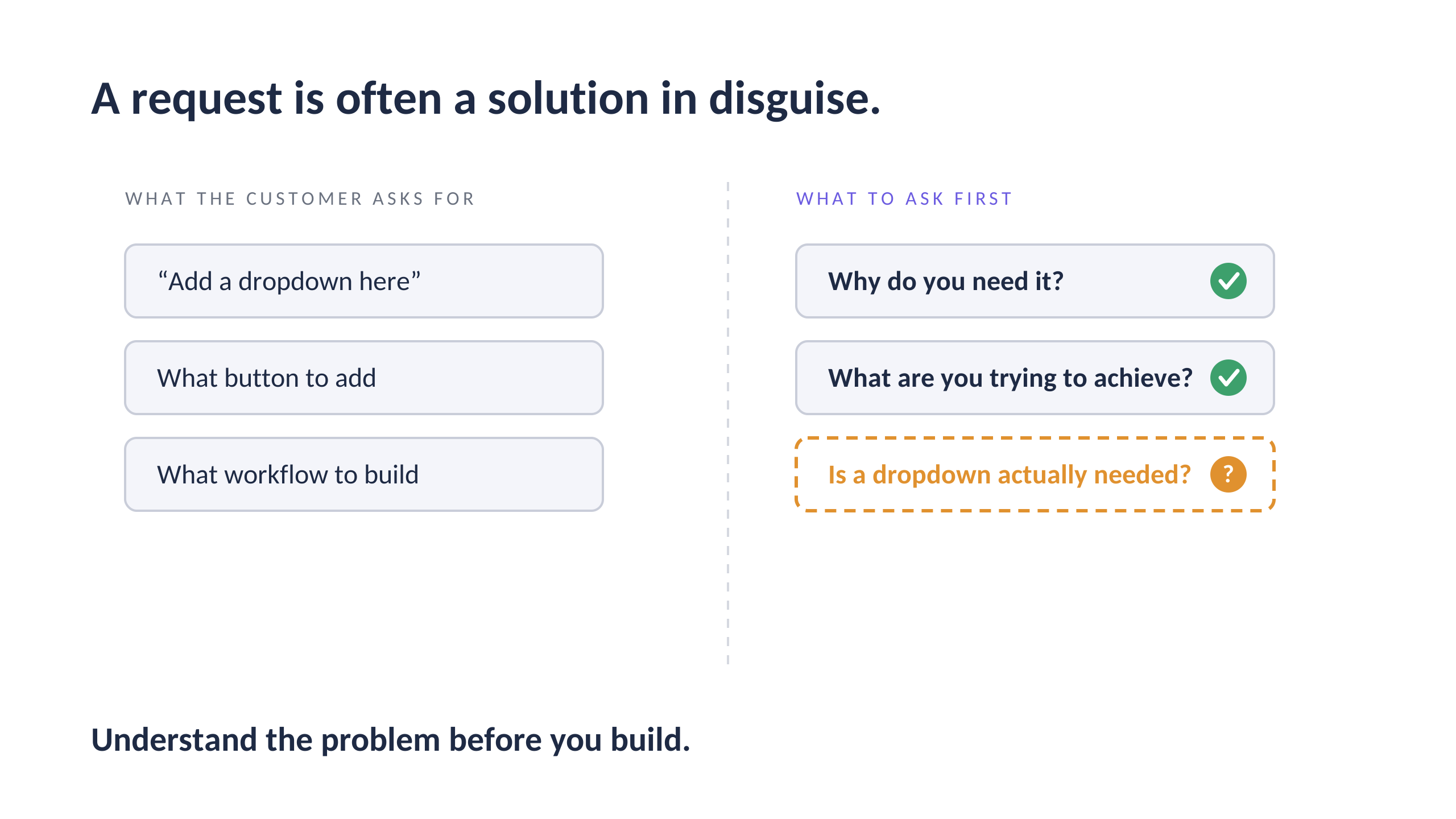
For example, a customer might come to me and say, "Hey, can we add a dropdown here?"
My first question would probably be, "Sure, but why do you need that dropdown?"
Because the customer is already suggesting a solution. What I really want to understand is the problem they're trying to solve.
Once I understand that, we can figure out whether a dropdown is actually needed or whether there's a better way to solve the problem.
And this happens quite frequently.
I don't think customers should necessarily have to tell us what button to add or what workflow to build. They should tell us what they're trying to achieve, and it's our responsibility to help them find the right solution.
So, for me, the biggest change has been moving from thinking about how to build something to understanding why we're building it in the first place.
And having that technical foundation makes a real difference when making those decisions.
2. Procurement and approvals often run on Excel, emails and a lot of follow-ups. What does it take to move that kind of work into a system people actually use?
I think the first thing is to understand that we're not necessarily trying to change how procurement professionals do their jobs.
They know their business, their suppliers, their procurement processes, and how to evaluate proposals. In many cases, those processes have been working for years.
I'm not questioning their expertise or the framework they follow.
What I would question is whether the tools they're using are slowing them down.
Think about a buyer managing multiple RFQs. Suppliers send proposals through emails, someone collects those emails, puts documents together, prepares comparisons, follows up for approvals, and maintains different Excel sheets to track everything.
Now, none of these activities is necessarily wrong. But look at how much time is being spent just managing information.
Imagine having a system where proposals are already organised, comparisons are easier, approvals follow defined workflows, and everything is available in one place.
The procurement professional can now spend more time evaluating proposals, negotiating, understanding commercial implications, and making the right decisions rather than chasing emails and consolidating spreadsheets.
And I'm not talking about simply digitising an existing process. There's much more to it.
It's about improving efficiency, automating repetitive work, bringing transparency, and allowing people to accomplish significantly more.
A buyer who could previously manage only a handful of RFQs in a week might now be able to handle considerably more. Some activities that took days could potentially be completed in hours.
And this isn't limited to procurement. You see similar challenges in project management, IT service management, and other business functions. The tools may be different, but the problem is often the same. People spend too much time managing information instead of doing the actual work.
I often compare this to building a house.
You can use a hammer to drive every nail, and nobody is questioning your ability to build that house.
But if you have a nail gun available, why wouldn't you use it?
You're still building the same house. You're just using better tools to do the work faster and more efficiently.
That's how I look at technology. It's not about replacing people's expertise. It's about giving them better tools so they can achieve much more with that expertise.
3. You recently started a new Atlassian Community chapter in Bhopal. What did the first meetup teach you about what people really want from a community?
I've been involved in creating and managing communities for quite a few years now.
The Atlassian Community in Indore is one example where we've built a very active community with regular events, strong engagement, different topics, and a growing audience.
Recently, I took on the additional responsibility of leading the Bhopal chapter.
Bhopal is a tier-two city in central India, and there hadn't been much Atlassian Community activity there for quite a few years.
One thing my experience with Indore has taught me is that there's no single template for building a successful community.
What works in New York might not work in San Francisco, Bangalore, Tokyo, or Bhopal.
Even Indore and Bhopal, which are geographically quite close and share many similarities, have different audiences and expectations.
So, when we started activities in Bhopal, the idea wasn't to immediately jump into teaching people Jira, Confluence, or any other Atlassian product.
The first step was to understand the audience.
And our first meetup was a really good experience.
One thing that became very clear was that people genuinely value opportunities to connect, network, and learn from each other.
We live in a time when remote and hybrid working are quite common, and they're great in their own ways. But people also value getting together, meeting like-minded professionals, exchanging ideas, and building relationships.
At the same time, they want opportunities to learn about new technologies, attend hands-on workshops, discuss challenges they face at work, and understand how others are solving similar problems.
And I think that's what makes a community interesting.
Sometimes you learn from someone presenting on stage. Sometimes you learn something equally valuable from the person sitting next to you.
For me, the biggest learning was that every community has its own needs, and you need to understand those needs before deciding what to offer.
As organisers, we can create opportunities, but the members should also play an important role in shaping what the community becomes.
4. When someone asks "who approved this, when, and why", how well can a typical setup answer, and where does it fall short?
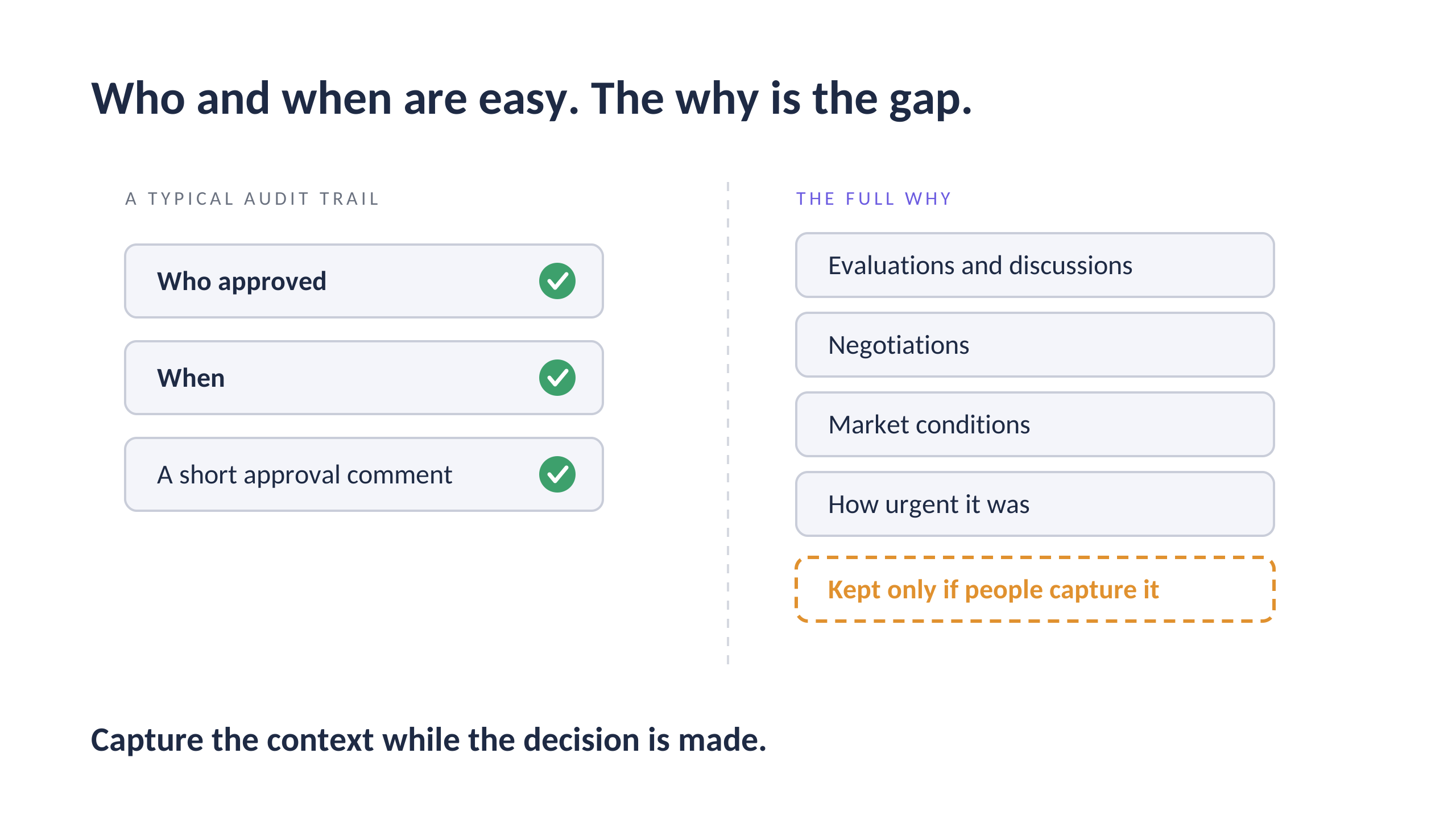
I think finding out who approved something and when is relatively straightforward, provided you have the right systems and audit trails in place.
But for me, the most important question is WHY.
And when I say why, I don't mean a couple of lines someone writes in an approval comment saying, "Approved because this meets our requirements."
There's much more to a business decision than that.
Take procurement, for example.
Why did we select a particular supplier? What technical evaluations happened? What were the commercial considerations? What did different stakeholders think? How did the negotiations go?
And sometimes, it's not even limited to what happened inside the organisation.
What were the market conditions at that time? Was there a supply shortage? Were geopolitical situations affecting availability or pricing? Was there seasonality involved? How urgent was the business requirement?
All these things come together when a business makes a decision.
Now imagine someone questioning that decision six months or two years later.
Knowing that John approved it on a particular date, along with a short approval comment, doesn't necessarily explain the complete picture.
You need to understand the entire journey behind that decision.
The documents, evaluations, discussions, approvals, negotiations, and the business context at that particular point in time.
And this thinking applies equally to platforms like Jira. Knowing that a ticket moved from one status to another is useful, but understanding the requirements, discussions, and decisions behind that change is equally important. A status history tells you what happened, but it doesn't always explain why it happened.
And that's where having the right systems and processes makes a difference.
A good system should help preserve and connect all this information so that someone looking back can understand not just what happened, but the reasoning behind it.
Of course, the system can only preserve the context that people actually capture. That makes having the right processes equally important.
For me, it's not just about knowing who approved something and when. It's about being able to explain why that decision made sense at that particular point in time.
That's what makes an audit trail genuinely useful.
5. What one piece of advice would you give someone who wants to start a community chapter in their own city?
The first thing I'd say is, don't look at starting a community chapter as another designation or achievement to add to your LinkedIn profile.
Building a community takes a lot of time and effort, and honestly, it's a job that doesn't pay you in the traditional sense.
So if you're doing it just to add another feather to your cap or strengthen your next job application, you're probably approaching it the wrong way.
Of course, if you're starting an Atlassian Community, you should know the ecosystem, understand the products, and have a genuine interest in the technology.
But that's only one part of it.
The bigger question is whether you understand why communities exist in the first place.
You need to understand your local audience. What are they looking for? What challenges are they facing? What opportunities are missing?
There are definitely frameworks and experiences from other successful chapters that can help you. But you cannot simply copy what another chapter is doing and expect the same results.
You need to be involved, connect with people, listen to them, and understand what would actually bring value to their professional lives.
And consistency matters.
You cannot just show up once every quarter, organise an event, and expect people to keep coming back without offering them something meaningful.
Give people opportunities to learn, network, share their experiences, and grow professionally.
And don't try to make everything about yourself as a community leader.
One thing I've learned is that you might be the person organising a chapter, but it's the people who actually make it a community.
So my advice would be to focus on building something that your local audience genuinely needs.
If you're able to do that consistently, the community will grow, and the recognition will come along the way.
Five lessons from Rishabh Jhawar
-
Ask why before you build. A request for a feature is often a proposed solution. Understand the problem first, then decide what is needed.
-
Better tools, same expertise. Moving work out of spreadsheets and email is not about changing how experts work, but about giving them time for the work that matters.
-
Every community is different. Understand your local audience before deciding what to offer.
-
Who and when are not enough. An audit trail becomes useful when the reasoning behind a decision is captured with it.
-
Show up consistently. A chapter is not a title. People come back when they get something meaningful, and they are the ones who make it a community.
Thank You
Our sincere thanks to Rishabh Jhawar for answers full of clear pictures, from the dropdown nobody really needed to the nail gun that builds the same house, and for his honest view on what it takes to build a community.
We truly appreciate your time and your openness.
About this series
5 Questions in the Atlassian Universe is an interview series by MetaFrazo featuring experienced practitioners from across the Atlassian ecosystem.
Each conversation explores practical lessons and real challenges from people who build, run and grow work in the Atlassian ecosystem.
Because the best ideas don't come from tools alone. They come from the people who use them every day.
About MetaFrazo
MetaFrazo turns the events of your Jira Cloud site into operational, governance and compliance analytics. See what changed. See who changed it. Without building a report.
www.metafrazo.cloud · Available on the Atlassian Marketplace
See you in the next edition of 5 Questions in the Atlassian Universe.
Interview conducted in writing.
Rate this post
Related articles
5 Questions with Robert Hean: Train for Day One
Robert Hean of Hean.Tech on training people the way he wished he had been trained, admin confessions and keeping the why next to every Jira change.
2026-11-19
5 Questions with Rolf Eriksen: Jira App Security
Rolf Eriksen of Eriksen Labs on why Jira automation can show a person as the author and what to ask any Marketplace app before you install it.
2026-10-28
Closed in Jira with no time logged: finding the reason
Why are Jira work items closed with no time logged? Combine the Jira event history with the team's resource plan to find the reason.
2026-11-17