

5 Questions with Akash Singh (Uber)
 Maria Reisinger·2026-10-15·8 min read
About Akash
Akash Singh · Atlassian Solution Architect at Uber, Community Champion and Forge developer · Bengaluru, India
"Good administration isn't just about preventing problems; it's about being prepared for the ones you can't prevent."
Akash has worked in the Atlassian ecosystem for years, helping customers solve organizational challenges. He completed every Atlassian certification and credential within eight months. After a team lost Epics and Stories that nobody could trace or recover, he built the Forge app Issue TraceBack. He is now rebuilding his capacity management app in public, this time with AI assistance.
Areas of expertise: Jira · Confluence · Forge · DevOps · CI/CD · Agile and SAFe
1. You completed every Atlassian certification and credential within eight months. What did working through the full portfolio teach you that day to day project work had not?
Having worked in the Atlassian ecosystem for years and helped multiple customers solve organizational challenges, I initially felt I had already seen and implemented most of what the platform had to offer. Honestly, I wasn't expecting to learn much more through certifications. However, that perspective changed quickly once I began the journey.
The learning process exposed me to a lot of nuances, hidden features, and gotchas that we often overlook simply because they don't fit into our day to day workflows. It also challenged some of my assumptions and helped me understand the products beyond just their practical implementation.
Working through the entire portfolio gave me a broader perspective on how the Atlassian ecosystem fits together and how different products, capabilities, and administrative functions complement each other. It has also influenced how I approach solution design, encouraging me to think beyond immediate requirements and consider scalability, governance, user experience, and adoption.
Ultimately, this journey wasn't just about earning certifications. It helped me connect the dots between my hands on experience and the broader Atlassian ecosystem, making me a more well rounded consultant.
2. You built Issue TraceBack after a team lost Epics and Stories that nobody could trace or recover. What did that moment teach you about what admins should record before they ever need it?
That experience taught me that good administration isn't just about preventing problems; it's about being prepared for the ones you can't prevent.
When the team lost critical work items that could neither be traced nor recovered, I realized that the questions people ask after an incident are predictable: What was lost, who made the change, and when did it happen? In this case, I couldn't answer any of them.
It reinforced my belief that audit data is a baseline, not a nice to have. Admins should maintain easily searchable audit logs that capture who performed an action, what was affected, and when it happened. For critical objects, capturing additional context can make all the difference when trying to reconstruct what was lost. This should go hand in hand with appropriate backups and an understanding of native recovery limitations.
Just as importantly, audit logs aren't about assigning blame; they're about giving teams facts instead of assumptions, helping them identify process gaps and permission issues.
That experience inspired me to build Issue TraceBack and changed how I approach administration. I now believe traceability and recoverability should be discussed before go live, not after the first incident. They need to be built into a system from day one, not treated as an afterthought when data goes missing.
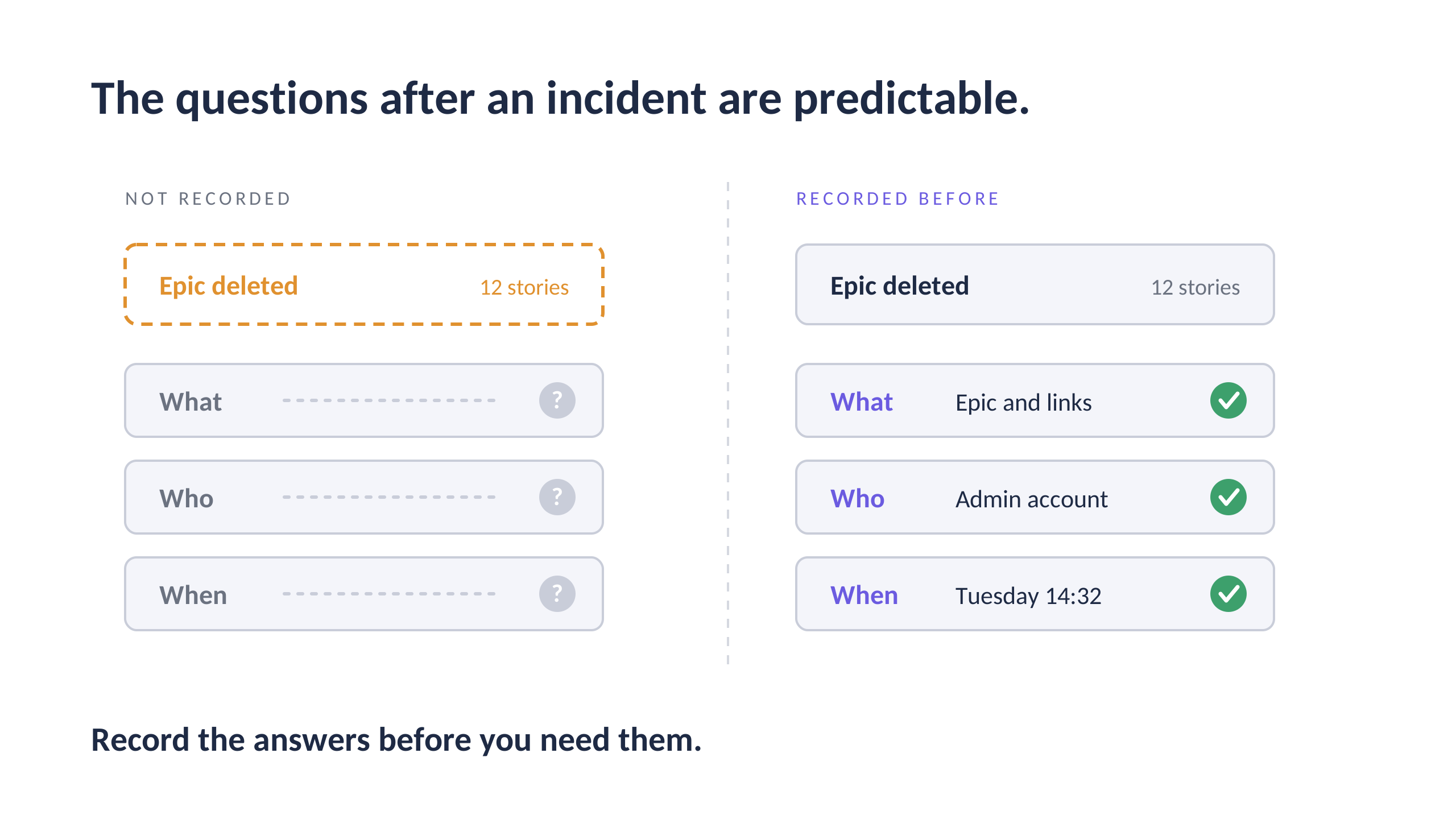
Illustration, not product data.
3. As a Forge developer, you know what an app can see and store inside Jira Cloud. What should admins ask any Marketplace app about the data it collects before they install it?
I'd focus on five key questions, many of which admins can start evaluating through the app's Marketplace listing and manifest.
What scopes does the app request, and why? Scopes determine what an app is permitted to access or modify in Jira. I'd validate each permission against the app's stated purpose and look for excessive access. Following the principle of least privilege helps minimize the attack surface, particularly if a vulnerability is discovered.
What data does it store and where? Does the app use Forge hosted storage, or does data leave Atlassian's infrastructure? Even seemingly harmless logs can contain personal information, such as account IDs, or sensitive content from issue summaries.
Does it send data outside Atlassian? I'd look at whether the app communicates with external services and what information it shares. Apps that qualify for the Runs on Atlassian badge can be simpler for customers to assess from a data residency and external data transfer perspective, potentially making security reviews and onboarding easier. However, the badge alone shouldn't replace due diligence.
What are its retention, deletion, and data residency policies? Admins should understand how long data is retained, how it's deleted, and where it's processed and stored. If data leaves Atlassian's infrastructure, a clear and robust Data Processing Agreement (DPA) can provide additional assurance around how the vendor handles it.
Who is accountable for security? I'd look for a clear security and privacy policy, a vulnerability disclosure process, and a point of contact for security incidents.
Ultimately, admins can't always see everything happening inside a Marketplace app, but they can ask Marketplace partners the right questions and evaluate whether the data collected and permissions requested are proportionate to the problem the app solves.
4. When an audit or security review asks "Who changed this, when, and why?", how well can a typical Jira Cloud environment answer that, and where are the gaps?
Atlassian has significantly improved its auditing capabilities in recent years, particularly with the introduction of Insights, which captures a broad range of app events. However, gaps remain in accessibility. Insights is limited to Atlassian Guard or Enterprise customers, while SIEM integration, which enables real time monitoring of suspicious activity, requires Guard Premium. This puts advanced security capabilities out of reach for smaller customers who may not have the budget for additional subscriptions.
At the in app level, audit logs often lack sufficient context about who made a change and don't capture the same breadth of events as Insights. But the biggest gap is still the why. Logs may tell us who performed an action and when, but rarely explain the business context or intent behind it. Deleted issues and their relationships can also be difficult to trace or reconstruct, even when using third party recovery apps.
This is why admins shouldn't rely solely on native audit capabilities. They need to understand what Jira records, how long that information is retained, and where additional logging or backups are necessary to ensure critical events remain traceable.
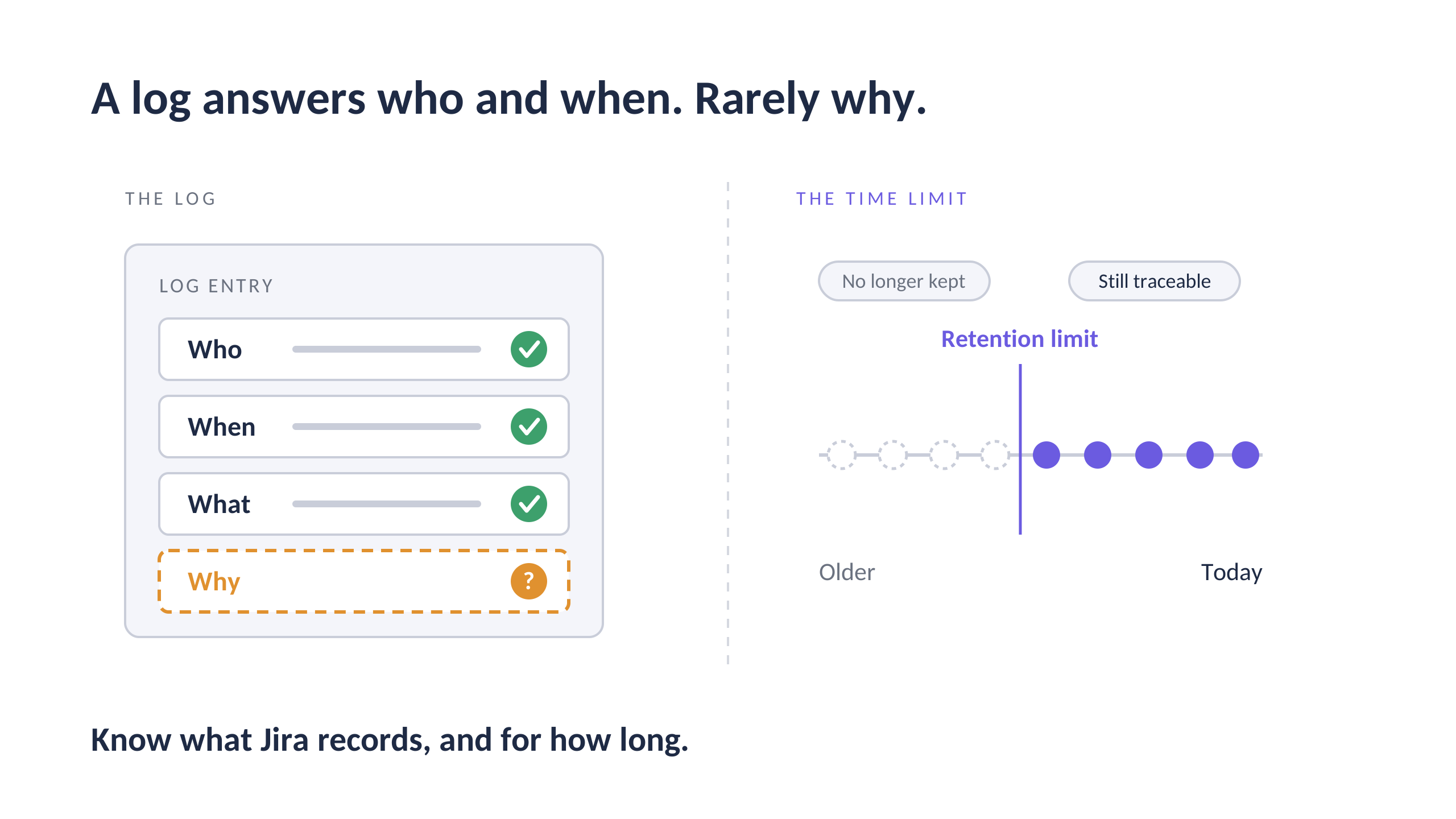
Illustration, not product data.
5. You are rebuilding your capacity management app in public, this time with AI assistance. How is AI changing what an Atlassian admin or app builder needs to know over the next few years?
I think AI is changing the role from someone who needs to know how to build everything manually to someone who understands what to build, why it matters, and how to validate it.
When I first built my capacity management app, I created the prototype in under two weeks without AI assistance. Rebuilding it now with AI has shown me how much faster we can move from an idea to a working solution. But speed alone isn't enough. You still need a solid understanding of the Atlassian platform, Forge architecture, security, permissions, and the underlying APIs to validate what AI generates and ensure it's production ready.
I believe the real differentiator over the next few years will be knowing enough to ask the right questions, challenge AI generated solutions, and make sound architectural decisions rather than simply knowing how to write code.
For Atlassian admins, this also means understanding how AI interacts with organizational data, permissions, governance, and security. For app builders, it means spending less time on boilerplate and more time solving actual customer problems.
Ultimately, I don't think AI will make platform expertise less important. It will make deep platform knowledge even more valuable, because building something is becoming easier, but building the right thing securely and reliably with appropriate guardrails remains the real challenge.
Five lessons from Akash Singh
-
Prepare for what you can't prevent. The questions after an incident are predictable, so the answers have to be recorded before it happens.
-
Treat audit data as a baseline. Who, what and when, searchable, together with backups and a clear view of native recovery limits.
-
Ask every app what it sees. Scopes, storage location, external transfers, retention and security accountability should fit the problem the app solves.
-
The why is rarely in the log. Know what Jira records and for how long, and add logging or backups where it matters.
-
AI makes platform knowledge more valuable. Building gets easier; validating what gets built stays your job.
Thank You
Our sincere thanks to Akash Singh for a perspective shaped by a real loss and turned into something every admin can use.
His point that traceability belongs in the conversation before go live, not after the first incident, is one many readers will take straight back to their own Jira.
We truly appreciate your time and your openness.
About this series
5 Questions in the Atlassian Universe is an interview series by MetaFrazo featuring experienced practitioners from across the Atlassian ecosystem.
Each conversation explores practical lessons, real challenges and proven approaches to managing Atlassian products at scale.
Because the best ideas don't come from tools alone. They come from the people who use them every day.
About MetaFrazo
MetaFrazo records your Jira event history continuously from the day it is installed and shows what changed, who changed it and how work moved across your projects, without building a report.
Recording starts with installation, so the earlier it runs, the more questions it can answer later.
www.metafrazo.cloud · Available on the Atlassian Marketplace
See you in the next edition of 5 Questions in the Atlassian Universe.
Interview conducted in writing, October 2026.
Rate this post
Related articles
The AI Shift in Jira: We May Be Asking the Wrong Question
AI is reshaping the Atlassian ecosystem quickly, and every new announcement raises the same worry about whether AI will replace Marketplace apps. This article argues that the more useful question is which problems AI can genuinely solve and which ones still need specialized products. AI is becoming the interface and it makes automation far easier, yet automation only answers what should happen next, while intelligence answers what is actually happening across hundreds of projects. Because operational risk builds up from many small, reasonable changes over time, the lasting advantage belongs to products that give organizations visibility into what their configuration is quietly doing, not just tools that perform individual tasks faster.
2026-08-04
5 Questions with Marie-Kathrin Organiszak (Uelzener)
Marie-Kathrin Organiszak, Product Owner Jira at Uelzener, on moving an insurer to the cloud, keeping Jira consistent across teams and tracing changes.
2026-10-08
5 Questions in the Atlassian Universe with Martin Runge
Martin Runge, Head of Atlassian Practice at XALT, on how long Jira actually remembers who changed what, why backup is more the customer's job than most Cloud teams realize, and what separates a logged change from an authorized one.
2026-09-10