

The AI Shift in Jira: We May Be Asking the Wrong Question
 Maria Reisinger·2026-08-04·7 min read
The AI Shift in Jira: We May Be Asking the Wrong Question
Artificial intelligence is changing the Atlassian ecosystem at a remarkable speed. Only a short time ago, most conversations were still about automation, workflow optimization, and cloud migration. Today those same conversations revolve around AI assistants, natural language interfaces, and products such as Rovo. Almost every new announcement seems to trigger the same underlying question: will AI replace Atlassian Marketplace apps?
It is an entirely understandable question to ask. AI can already summarize documentation, explain Jira configurations, generate automation rules, and answer detailed questions in plain language. Tasks that once required real experience or a dozen separate clicks can increasingly be completed with a single prompt, so it is tempting to assume that AI will eventually absorb much of what Marketplace applications do today.
I believe that is actually the wrong question to focus on. The more interesting one is not whether AI will replace apps, but which problems AI can genuinely solve and which ones will continue to need specialized products. That distinction matters not only for vendors, but also for the customers who are deciding where to put their time, budget, and trust.
AI Changes the Interface
One of the most visible changes that AI brings is to the interface itself. For years, most people learned Jira through menus, configuration screens, and long documentation. Increasingly, we now interact with the software through ordinary conversation instead. Rather than searching through a dozen settings, a user can simply ask the system to create an automation that assigns every new security issue to the platform team, to summarize the changes made in this sprint, or to explain why a particular workflow failed. The software then translates that request directly into an action.
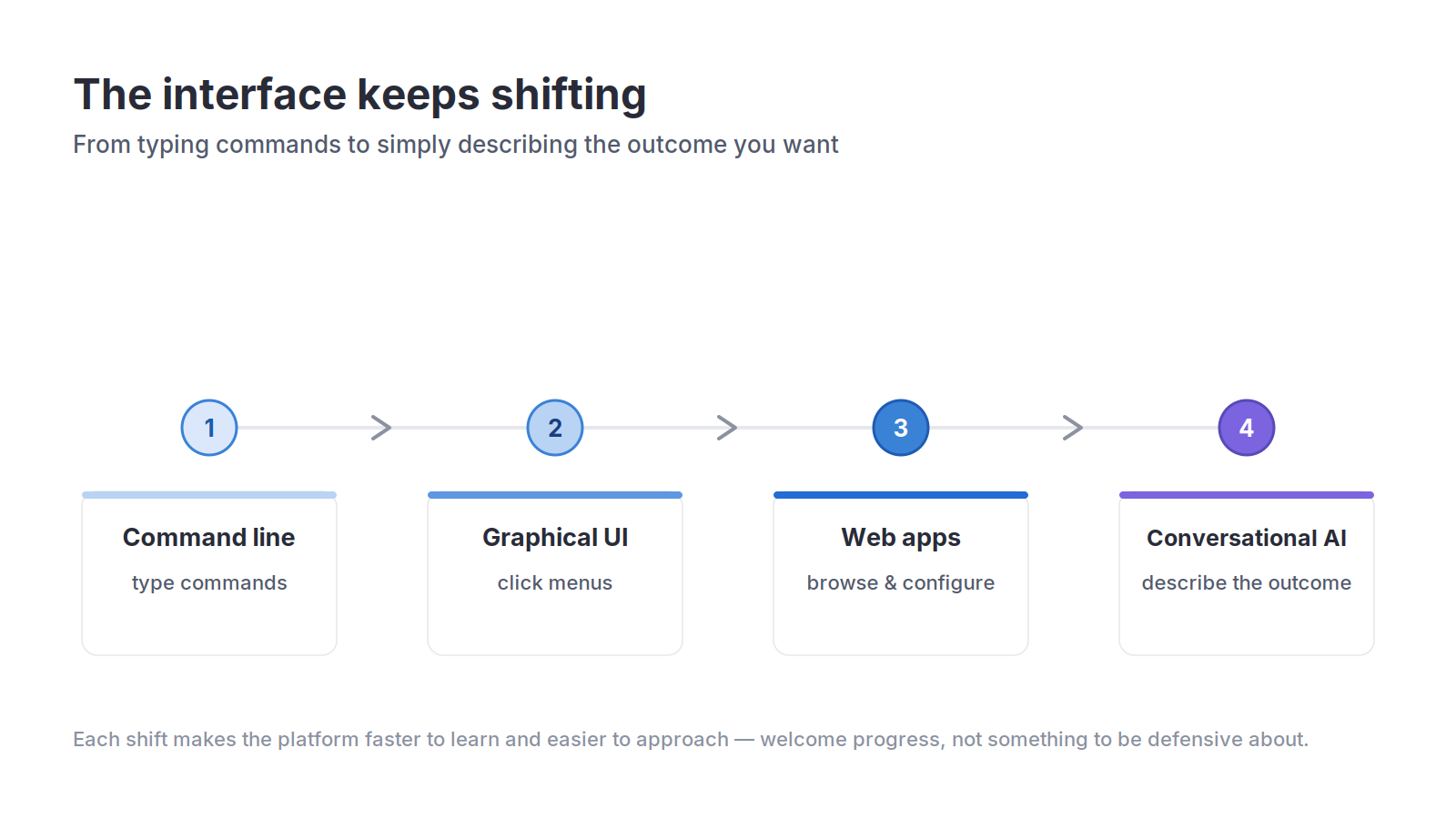
This is a genuine shift, and interfaces have always shifted in this way. Command lines became graphical interfaces, graphical interfaces became web applications, and now we are moving into conversational ones. That evolution helps almost everyone involved. Users become productive more quickly, administrators spend less time teaching the basic tasks, and complex products become far easier to approach. None of this is something worth being defensive about, and on balance it should be recognized as real and welcome progress.
Automation Is Becoming Easier
Automation is one of the first areas where this progress already shows real value. Creating automation rules used to require administrators to understand triggers, conditions, branches, and actions, and the experienced ones became experts precisely because they knew how those pieces fit together. With AI, much of that manual assembly work simply disappears. Instead of wiring up each component by hand, an administrator can now describe the outcome they actually want: when a critical incident is created, notify the incident manager, open a linked task for the infrastructure team, and raise the priority if customer impact is high. A first working version of the rule then appears within a few seconds.
That change lowers the barrier to automation considerably, and it is genuinely good news. Routine work becomes easier to handle, teams save meaningful time, and good practices become available to people who would never have built them from scratch.
But Automation Is Not Intelligence
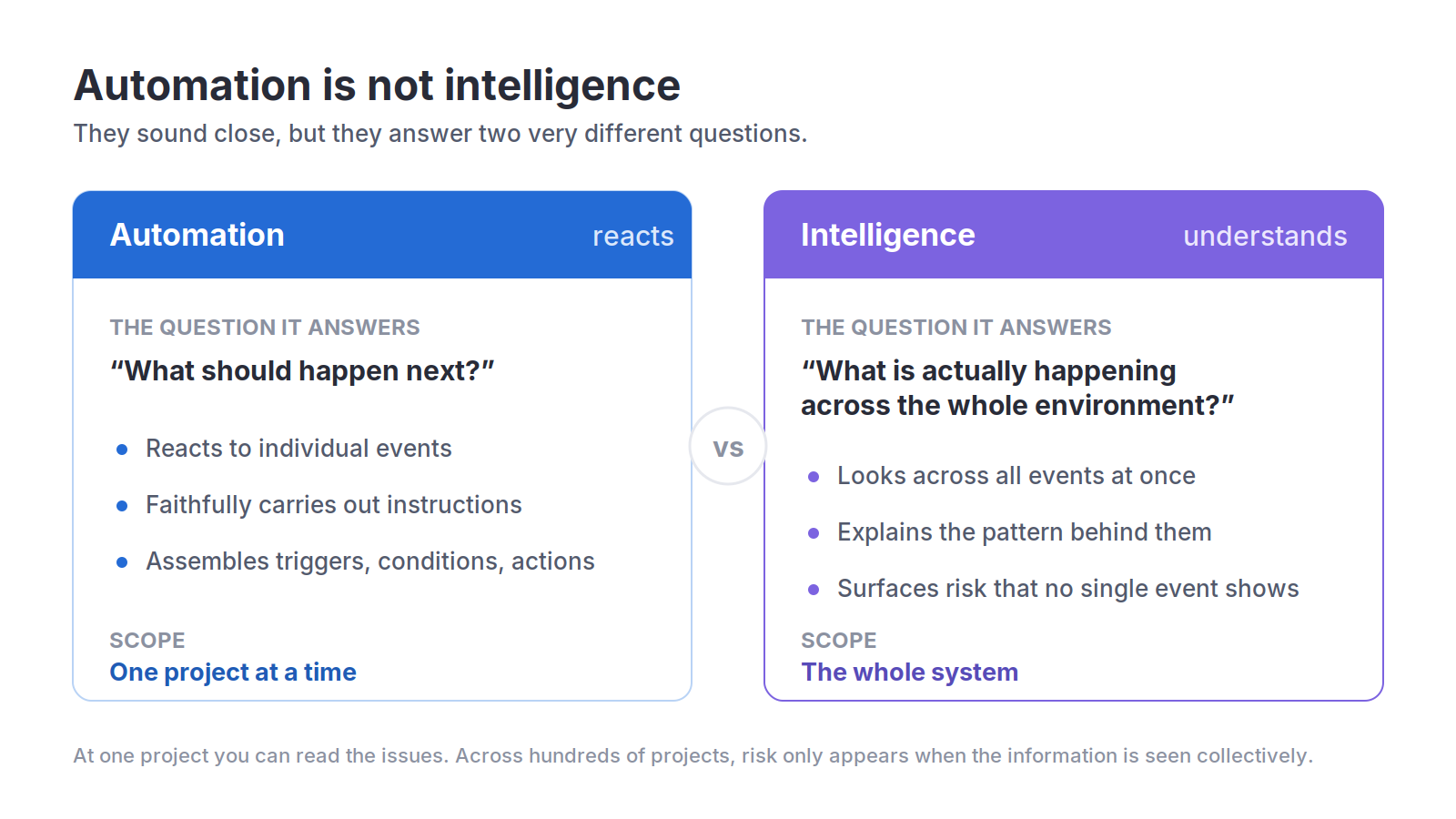
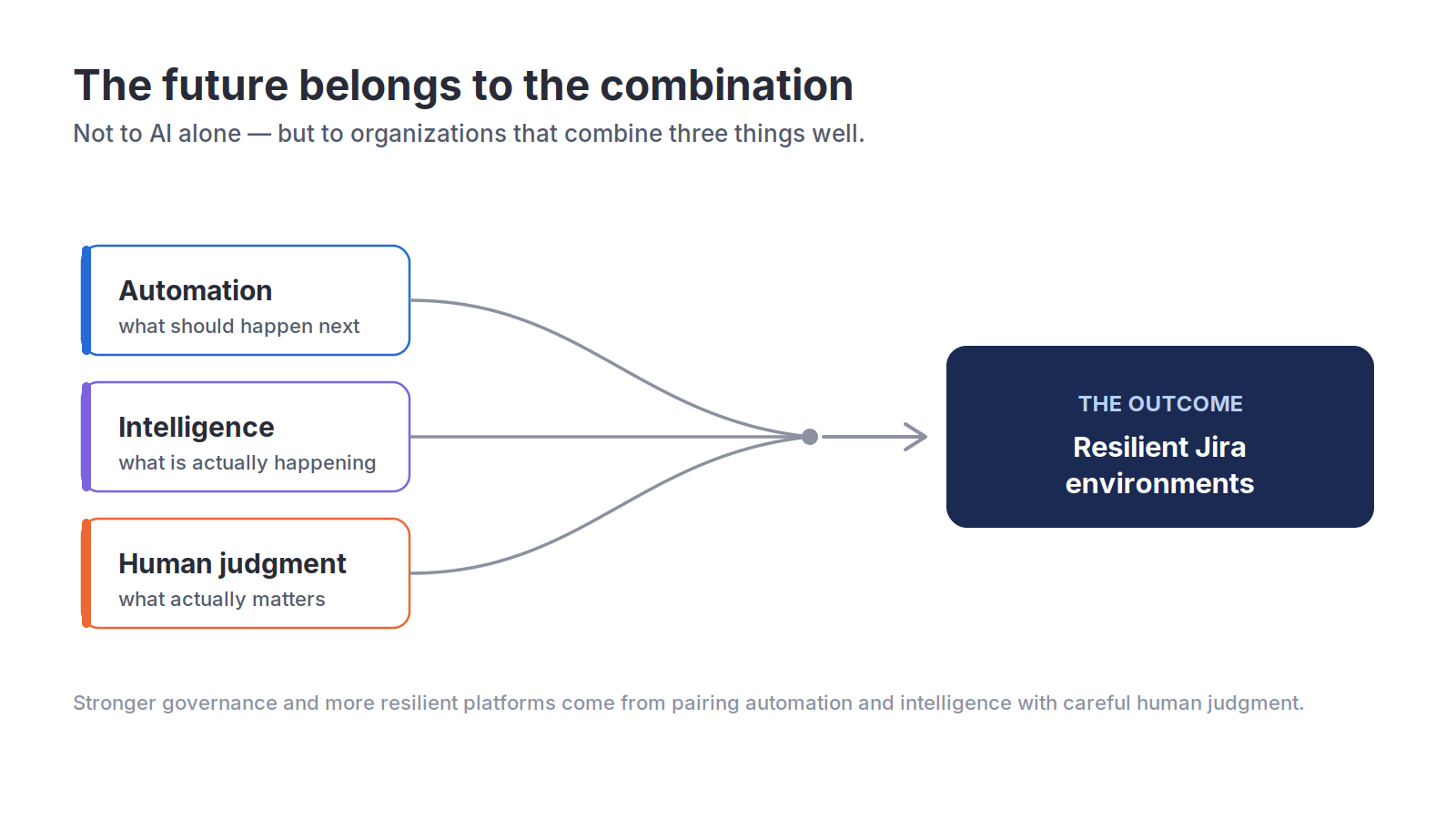
This is usually the point where the conversation about the future starts to oversimplify things. Automation answers one narrow question: what should happen next? Intelligence answers a very different one: what is actually happening across the whole environment? Those two questions sound close together, but they are not the same problem at all. Automation reacts to events and faithfully carries out instructions, while intelligence looks across all of those events and tries to explain the pattern behind them.
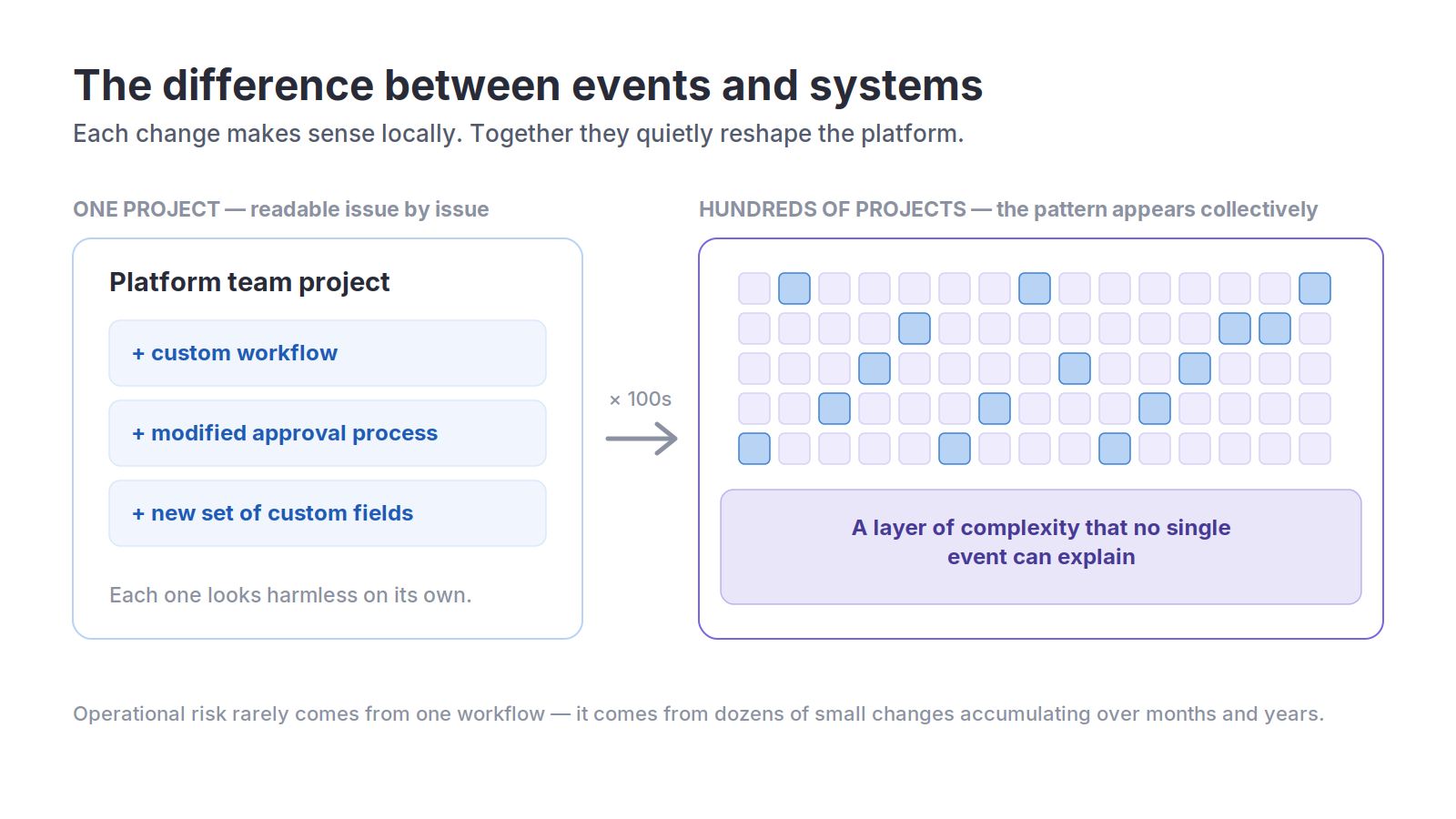
The difference stays fairly small until you scale it up. A single project can usually be understood by looking closely at its individual issues. An enterprise with hundreds of projects simply cannot be understood that way. Patterns only appear when the information is seen collectively, and operational risk rarely comes from any one workflow. It comes instead from dozens of small changes that accumulate over months or years, none of which looked dangerous on its own, yet which together quietly reshape the entire platform.
The Difference Between Events and Systems
Most AI demonstrations tend to focus on individual events in isolation. They show the model summarizing a single issue, generating a workflow from a short description, or explaining why one specific permission behaves the way it does. These are genuinely useful capabilities to have available. But enterprise platforms rarely become hard to manage because someone could not create an automation. They become hard to manage because small inconsistencies gradually spread across hundreds of different teams. One project creates a custom workflow, another modifies an approval process, and a third introduces a new set of custom fields. Each of these decisions makes complete sense in the place where it is made. Collectively, however, they add a layer of complexity that no single event can explain, and that only long-term observation ever makes visible. As organizations keep scaling upward, that distinction between the individual event and the whole system becomes much harder to ignore.
The Next Competitive Advantage
It is entirely fair for Marketplace vendors to ask how AI will affect their own products, and some categories will clearly feel more pressure than others. Applications whose main value is generating content, writing descriptions, or simplifying configuration will increasingly overlap with what the platform can already do natively. That is simply the way platforms tend to evolve over time. Features that turn out to be universally useful usually migrate into the platform itself, and this pattern has repeated many times before.
The more interesting opportunity actually lies somewhere else entirely. Organizations do not buy software because they happen to enjoy its features. They buy software because they need better decisions, clearer visibility, lower operational risk, and more confidence in what they are looking at. Those needs do not disappear when AI becomes very good at performing individual tasks. If anything they only grow, because the faster AI accelerates change, the more transparency an organization needs in order to understand what that change is quietly doing.
AI Does Not Remove Complexity
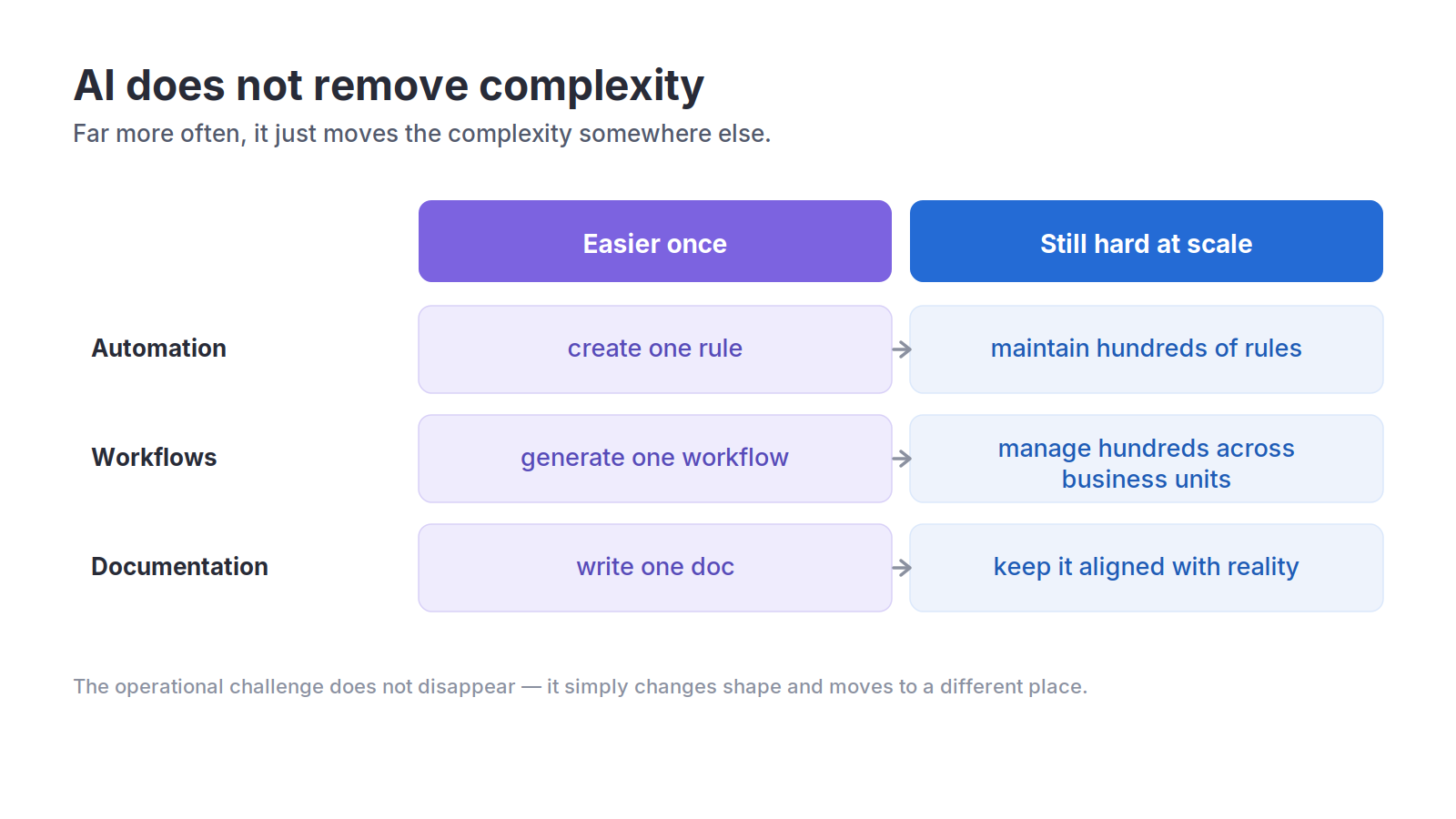
There is one more common assumption worth questioning here, which is the idea that AI removes complexity altogether. In practice, it far more often just moves that complexity somewhere else. Creating a single automation becomes easier, while maintaining hundreds of automations remains genuinely hard. Generating one workflow becomes easier, while managing hundreds of different workflows across many business units remains hard. Writing documentation becomes easier, while keeping that documentation aligned with reality remains difficult over time. The operational challenges themselves do not actually disappear, they simply change their shape and move to a different place.
Looking Ahead
The Atlassian ecosystem has always adapted remarkably well to this kind of technological change. Cloud reshaped how software is deployed, automation reshaped how teams stay productive, and AI is now reshaping how we interact with the platform. But the next stage may not really be about performing even more actions. It may instead be about understanding, far more deeply, what all of those actions actually add up to over time.
That is exactly why I keep coming back to a different question. Instead of asking whether AI will replace Marketplace apps, it seems much more useful to ask which problems become more important once AI has made everything else easier. I suspect the answers will shape the next generation of successful products, stronger governance practices, and more resilient Jira environments. The future almost certainly does not belong to AI alone. It belongs to the organizations that learn to combine automation, intelligence, and careful human judgment.
I would be very glad to hear how you see this developing. Which kinds of Marketplace apps do you believe will become more valuable in an AI-driven Atlassian ecosystem, and which ones are most likely to disappear over time?
Rate this post
Related articles
5 Questions in the Atlassian Universe with Martin Runge
Martin Runge, Head of Atlassian Practice at XALT, on how long Jira actually remembers who changed what, why backup is more the customer's job than most Cloud teams realize, and what separates a logged change from an authorized one.
2026-09-10
How to Detect Workflow Bypass in Jira
Skipped reviews look exactly like speed on a velocity dashboard. How the Bypass Risk Score turns workflow events into one number per project.
2026-08-14
Atlassian Analytics and Jira Governance: Who Owns the Query?
Every audit asks the same Jira questions, and nobody owns the query. What Atlassian Analytics offers, who it is built for, and where MetaFrazo adds to it.
2026-09-28