

How to Detect Workflow Bypass in Jira
 Maria Reisinger·2026-08-14·8 min read
Your dashboards reward speed. A skipped review looks exactly like speed.
In theory, a governance-conscious admin could check the health of every project by hand. Each morning, open three reports side by side: how often work skips the steps in between, how often finished work comes back, how much has quietly stopped moving. Read them project by project. In a five-project instance, that is a ten-minute habit. In an estate with eighty projects, nobody sustains it past the second week.
So the exercise quietly stops. Not because it stopped mattering, but because it does not scale. And that is precisely the moment the risk begins, because those signals keep changing whether anyone reads them or not.
Jira is never static. New projects are created, teams fall behind, deadlines compress. A workflow gets bypassed once under pressure, and then again, because the first time nothing bad happened. Each of these is a local, reasonable decision. None of them looks like a problem on its own.
Over time, though, those individual decisions accumulate into a pattern that no single dashboard shows. Velocity still looks fine, often better, because skipping a review makes a team faster on paper. Nothing stops working. And a project can drift a long way outside its own governance boundaries while every chart on the wall stays green.
The uncomfortable part is that none of this is hidden data. Every skipped step, every reopen, every stuck issue is already recorded in your Jira event stream. The information was always there. What was missing was a single place to read it, and someone with the time to read it every morning.
What the Bypass Risk Score actually measures
The Bypass Risk Score gives every project a single number, recomputed continuously from workflow events rather than from a quarterly export. It reflects two habits at once: work that reaches a finished state without passing through the steps that were supposed to come first, and work that gets called finished and then has to be picked back up.
The score has two thresholds that matter, 40 and 70. Below 40 the project is operating within normal bounds and reads LOW. Between 40 and 70 it reads MEDIUM: something is emerging that will escalate if left alone. Above 70 it reads HIGH: something is structurally wrong and needs escalation now.
Stuck work is the third thing worth watching, but it is not in the score. It sits alongside, in its own view, and we will come to it. For now the point is what the score is telling you when it climbs: a project is both skipping steps and redoing work, in the same window. A single high number is rarely one thing going wrong. It is two habits slipping at once, which is exactly why a HIGH gauge is worth an interruption to your morning.
And it is worth being honest about what the number does not do. It tells you where, and how serious. It does not tell you why, and it does not pass judgment. A bypass can be someone cutting a corner, or it can be a workflow so rigid that reasonable people route around it to get their work done. The score is a prompt to look, not a verdict.
The first question is no longer "is anything wrong," it's "where do I start"
Before opening any detail view, every admin with more than a handful of projects is really asking one question:
If I only had time to look at one project this morning, which one?
The gauges answer exactly that.

Screenshot 1 · Bypass Risk Score per Project
A gauge for every project with a scoreable history, each one reading LOW, MEDIUM, or HIGH as its score crosses 40 and 70. A genuinely clean project, one with no detected bypass at all, is not on the grid; its absence is the good news. The example here is a mid-sized estate where ten of fifteen projects read MEDIUM and the highest reads 50. No crisis, but a clear ranking of where attention is scarcest. That ranking is the value. The one you actually want is the morning a project that sat quietly near the bottom has climbed past its neighbors, and has done so before anyone cross-referenced anything.
What you can conclude
HIGH is not one problem. It is two habits failing together in the same project. It warrants investigation now, not at the next review cycle.
MEDIUM is a trajectory, not a crisis. The project has something emerging that will escalate if nobody looks. It belongs on a watch list.
The comparison is the insight. Reading the gauges side by side shows, in a single glance, where governance attention is scarcest relative to everywhere else. It replaces the act of cross-referencing report after report every morning with one row of dials.
Knowing a project is at risk isn't enough
Finding the project is only the first step. The score tells you a project is slipping. It does not tell you whether that is one person's habit or a whole team under strain, and those are opposite problems.
Is this one person's habit, or a whole team under strain?
The gauge cannot tell them apart. The actor view can.
Screenshot 2 · Actor-Level Bypass Fingerprint
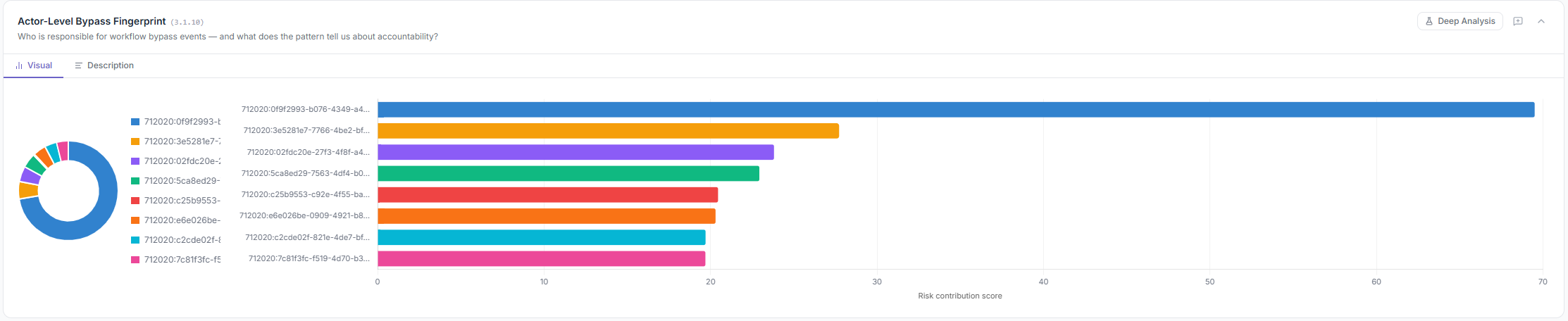
Pick the project, and the fingerprint ranks the people in it by how much of the project's skipped and redone work traces back to them. The identifiers are pseudonymous Atlassian account IDs, never names or email addresses. This is pattern visibility, not surveillance of individuals: the point is to see the shape of the behavior, not to build a case against a person.
How to read it
One person well above the rest points to a habit, not an accident. It is common for a single account to make up the bulk of a project's skips and reopens while everyone else sits far below, as in the example here. Very often that person is the most senior, most trusted engineer on the team, precisely because trust is the one place nobody thinks to audit.
An even spread across many people points the other way entirely. When everyone is skipping a little, the problem is usually the workflow itself, or the pressure the team is under, not any individual.
The distinction changes the remediation completely. One is a quiet conversation with one person. The other is redesigning a step that everybody has already decided to route around.
The third thing the score doesn't see
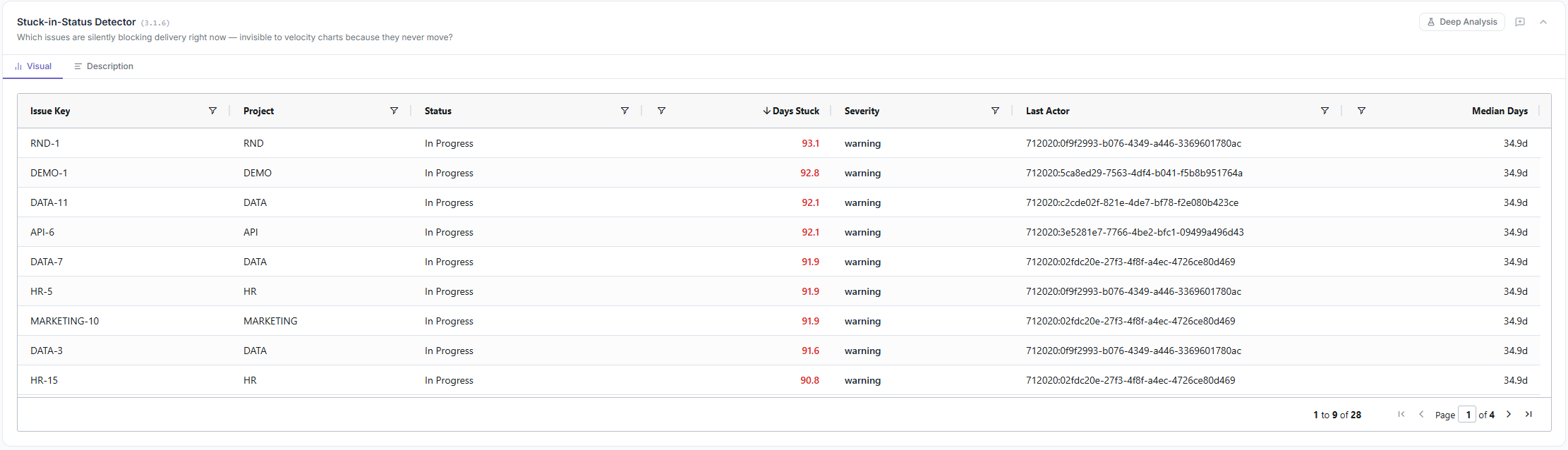
Bypass and reopen are what the score watches. The third thing you watch sits outside it. Some issues do not get skipped and do not come back. They simply stop, in a status, far longer than their peers, and stay there. They are invisible to a velocity chart precisely because they never move: nothing gets logged, nothing changes, so nothing draws the eye.
Screenshot 3 · Stuck-in-Status Detector
The detector surfaces exactly those issues, the ones sitting well beyond the normal time their neighbors spend in the same status. In the example here every stuck issue sits in the same status, which is itself the finding: when a queue backs up, it backs up in one place. A bypass is work moving too fast through the gates. A stuck issue is work that has quietly stopped. You read them together because they fail in opposite directions, and a project can be doing both at once.
Governance isn't a Monday-morning ritual
The manual three-report habit was point-in-time, and it did not scale. That is the deeper shift here. None of this stops recomputing.
A project's risk is not a snapshot you took in Q1 and filed away. It is today's picture, built from events that arrived seconds ago. That changes the question you bring to your dashboard, from "let me remember to check this" to "show me what moved."
Screenshot 4 · Portfolio Workflow Anomaly Heatmap
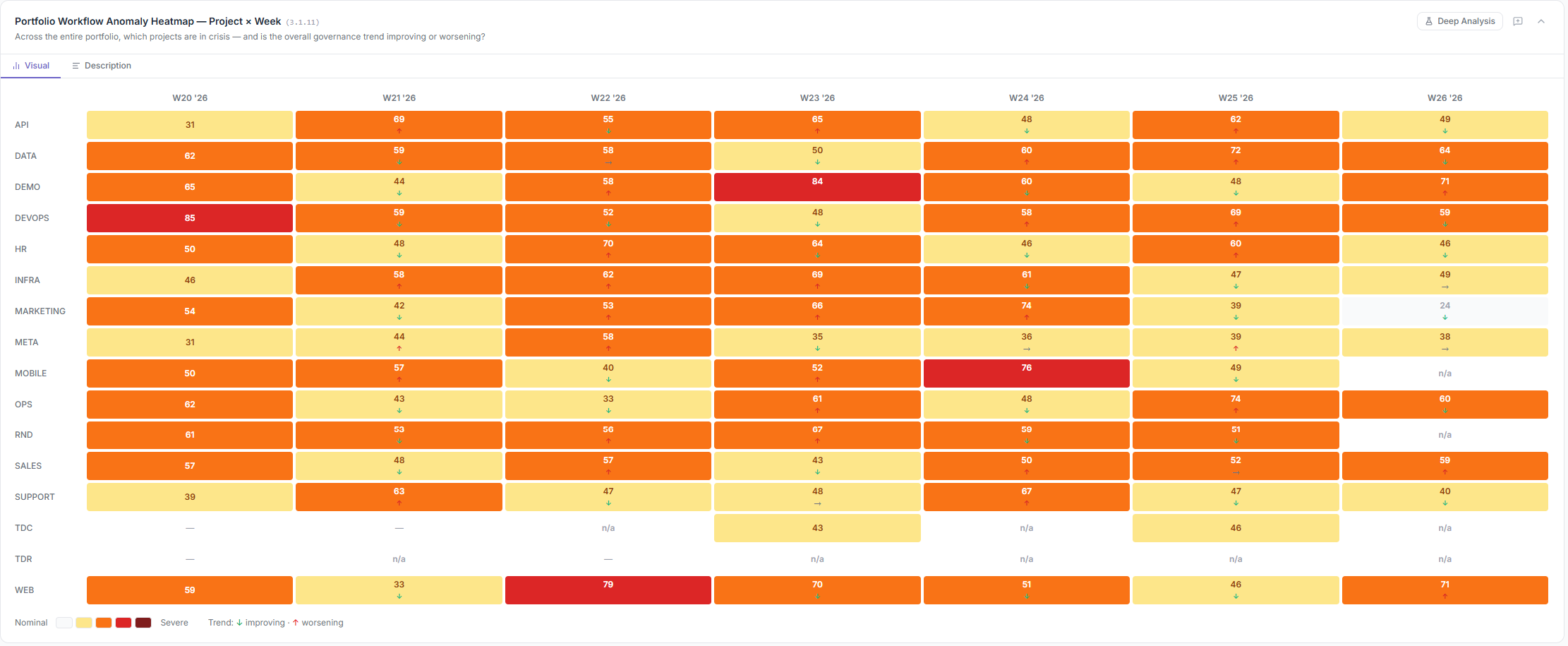
At portfolio scale, the heatmap puts the whole estate on one screen: every project down the side, recent weeks across the top, each cell shaded from nominal to severe. You can see which projects are heating up week over week and whether the estate as a whole is trending better or worse. Blank cells are projects with too little activity that week to score, which is itself worth knowing. It is the always-on version of the morning cross-reference, computed for you every day, so your attention goes to the projects that actually moved instead of to the act of checking.
From a habit nobody keeps to a system that doesn't forget
The morning cross-reference was a good instinct. It failed for one reason only: it depended on a person having the time and the discipline to run it across a growing estate, every day, indefinitely. The tooling keeps the instinct and removes the dependency. Instead of asking whether anything changed, you are shown what did.
That is the whole move. Not more data. The same data, finally in one place, read by the same eye, on the same morning.
Final thought
Workflow bypass rarely arrives as a scandal. It arrives as a series of small, defensible choices. A gate skipped to make a release. A review waved through because the person is trusted. A stuck ticket everyone assumed someone else was watching. Each one is reasonable. None of them trips an alarm. And a dashboard built to celebrate throughput will happily show a project moving faster, right up until the morning that something which never got checked comes back as an incident.
The signals were never missing. They were just never in the same place, read at the same time, by someone who could act on them. Putting them there, as a number recomputed while you sleep, is a small change. It is also the difference between a governance problem you find yourself, early, and one that eventually finds you.
A well-governed Jira estate is not one where no one ever bypasses the workflow. It is one where, when they do, the number moves, and someone sees it in time.
You'll find us on the Marketplace: marketplace.atlassian.com/vendors/684225822/metafrazo
Rate this post
Related articles
Atlassian Analytics and Jira Governance: Who Owns the Query?
Every audit asks the same Jira questions, and nobody owns the query. What Atlassian Analytics offers, who it is built for, and where MetaFrazo adds to it.
2026-09-28
The color decides, not the number
Four teams estimate in four different units, and one dashboard turns them into a single colour. When the bar is green, nobody asks what the number underneath actually means. The gap this opens up only matters when someone asks what a decision was based on. And that is where the configuration and the event history start to disagree.
2026-08-17

Jira Audit Log Retention: How Long Jira Cloud Actually Keeps Your History
The site audit log holds up to six months, the organization log 180 days, automation logs 90. Audits ask about periods that are longer than all three. Why evidence has to exist before anyone asks for it, and what continuous history changes.
2026-09-14