
Atlassian Guard Premium DLP: Why Data Protection Alone Isn't the Whole Compliance Story
 Maria Reisinger·2026-07-22·3 min read
Atlassian's introduction of Data Loss Prevention (DLP) in Guard Premium is one of the most significant security announcements for Jira and Confluence administrators this year.
Automatic detection of sensitive information, data classification and centralized protection policies are capabilities many organizations have been waiting for.
Since the announcement, however, I've heard the same question several times:
"If Guard Premium now provides DLP, does that also cover our governance and compliance requirements?"
The answer depends on which compliance question you're trying to solve.
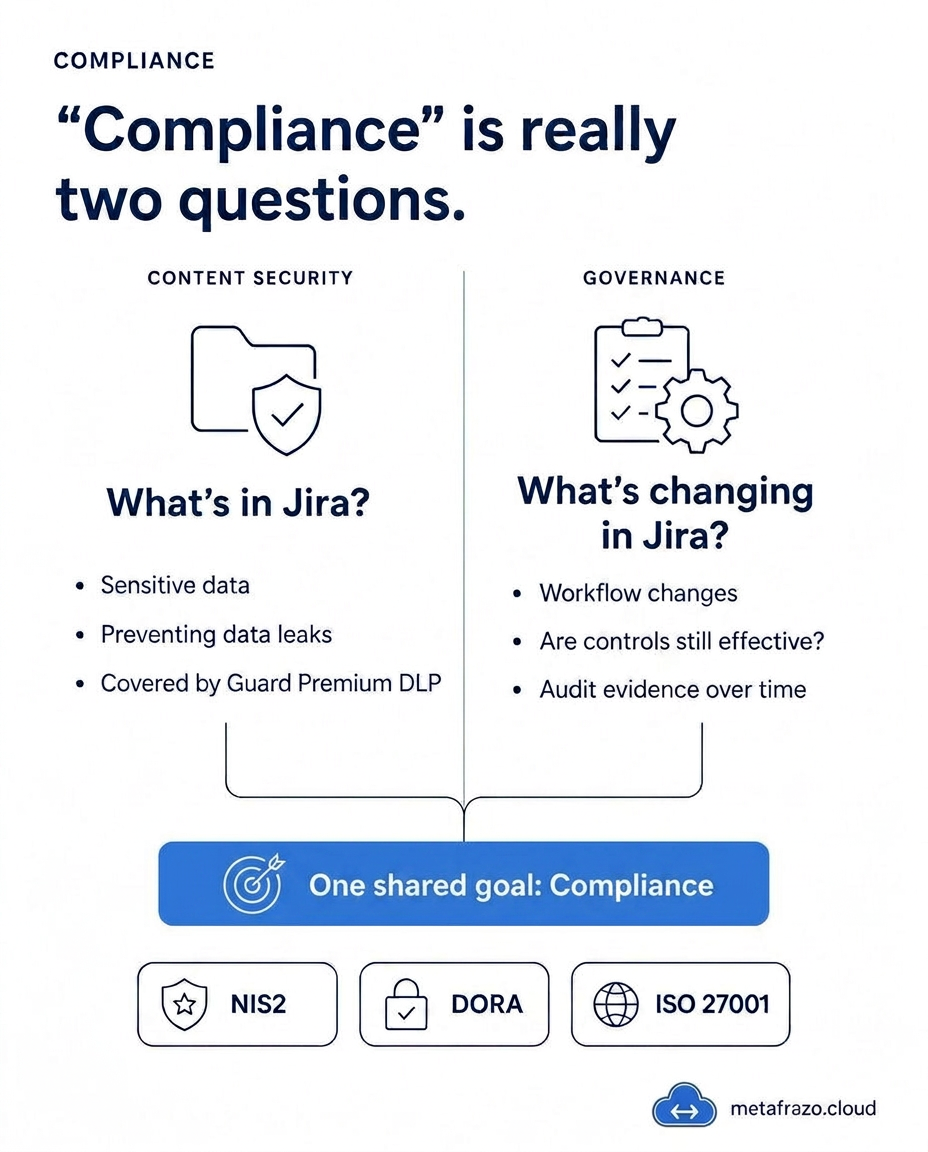
One platform. Two different compliance questions.
When discussing compliance, two topics are often mixed together.
The first is content security.
Questions like:
-
What sensitive information exists in Jira?
-
Where is personal data stored?
-
How do we prevent confidential information from being shared or exported?
These are exactly the questions Guard Premium is designed to address.
But auditors often ask a second set of questions.
-
Who changed a workflow?
-
When was an approval rule removed?
-
Are our governance controls still effective?
-
Can we demonstrate that critical configuration changes were properly managed?
These questions are fundamentally different.
They are not about the content stored inside Jira.
They are about the governance of Jira itself.
A practical example
Imagine a release workflow that requires QA approval before software can move into production.
An administrator accidentally removes the workflow validator enforcing that approval.
Nothing immediately breaks.
Releases continue, now without the control that was supposed to protect them.
The change is recorded. But no one is looking, because nothing appears to be wrong.
Several weeks later an auditor asks:
-
How long was this control missing before anyone noticed?
-
What prevented releases from shipping without QA approval during that window?
-
How do you demonstrate the control was operating effectively the whole time, not just that a change happened?
-
Which other controls could silently drift the same way?
-
How do you know your release process is compliant right now, and not just when someone thinks to check?
Guard Premium provides valuable audit and security information. It can tell you that a change occurred, if you go looking for it.
What it does not do is continuously evaluate whether your workflow design, governance controls and configuration still align with your organization's internal policies and regulatory requirements, and alert you when they don't.
A log is a passive record. Governance is active, ongoing assurance. That is a different control objective.
Two complementary layers
I find it helpful to think about compliance as two complementary layers.
Content security asks whether the right information is protected: sensitive data is identified, protection policies exist, confidential data is handled correctly.
Governance asks whether the system stays trustworthy over time: critical configuration changes are controlled, approval processes stay intact, administrative actions remain traceable, and controls keep operating as intended.
Each layer covers ground the other doesn't. Classifying a document tells you what's sensitive; tracking configuration change tells you that a validator disappeared three weeks ago. Different questions, different answers. Together they give you the complete picture.
Why this matters
Frameworks such as NIS2, DORA and ISO 27001 don't prescribe specific products.
Instead, they expect organizations to implement appropriate technical and organizational controls and to demonstrate that those controls remain effective over time.
In practice this means organizations often need evidence for both:
Content protection
-
Sensitive information is identified.
-
Appropriate protection policies exist.
-
Confidential data is handled correctly.
Governance
-
Critical configuration changes are controlled.
-
Approval processes remain intact.
-
Administrative actions are traceable.
-
Governance controls continue to operate as intended.
These are related topics, but they solve different problems.
Final thoughts
I believe Atlassian Guard Premium is a significant step forward for enterprise security.
Data Loss Prevention fills an important gap for organizations that need better visibility into sensitive information stored across Jira and Confluence.
At the same time, governance remains a separate discipline focused on process integrity, configuration management and continuous oversight.
Understanding the distinction between these two perspectives helps organizations build a more complete compliance strategy instead of expecting a single tool to solve every control objective.
I'm curious how others approach this.
Do you treat content security and governance as separate control areas, or are they still combined in your organization?
Rate this post
Related articles

Jira Audit Log Retention: How Long Jira Cloud Actually Keeps Your History
The site audit log holds up to six months, the organization log 180 days, automation logs 90. Audits ask about periods that are longer than all three. Why evidence has to exist before anyone asks for it, and what continuous history changes.
2026-09-14
5 Questions in the Atlassian Universe with Martin Runge
Martin Runge, Head of Atlassian Practice at XALT, on how long Jira actually remembers who changed what, why backup is more the customer's job than most Cloud teams realize, and what separates a logged change from an authorized one.
2026-09-10
What DORA Really Asks of Your Approvals
DORA no longer asks whether an approval control exists, but whether it still works across your whole Jira over time. That drift never shows in a single ticket. Here is where Article 9 fits, and why the evidence you need is already in your Jira history.
2026-08-19